





How Gas Struts Differ from Gas Springs and Shock Absorbers
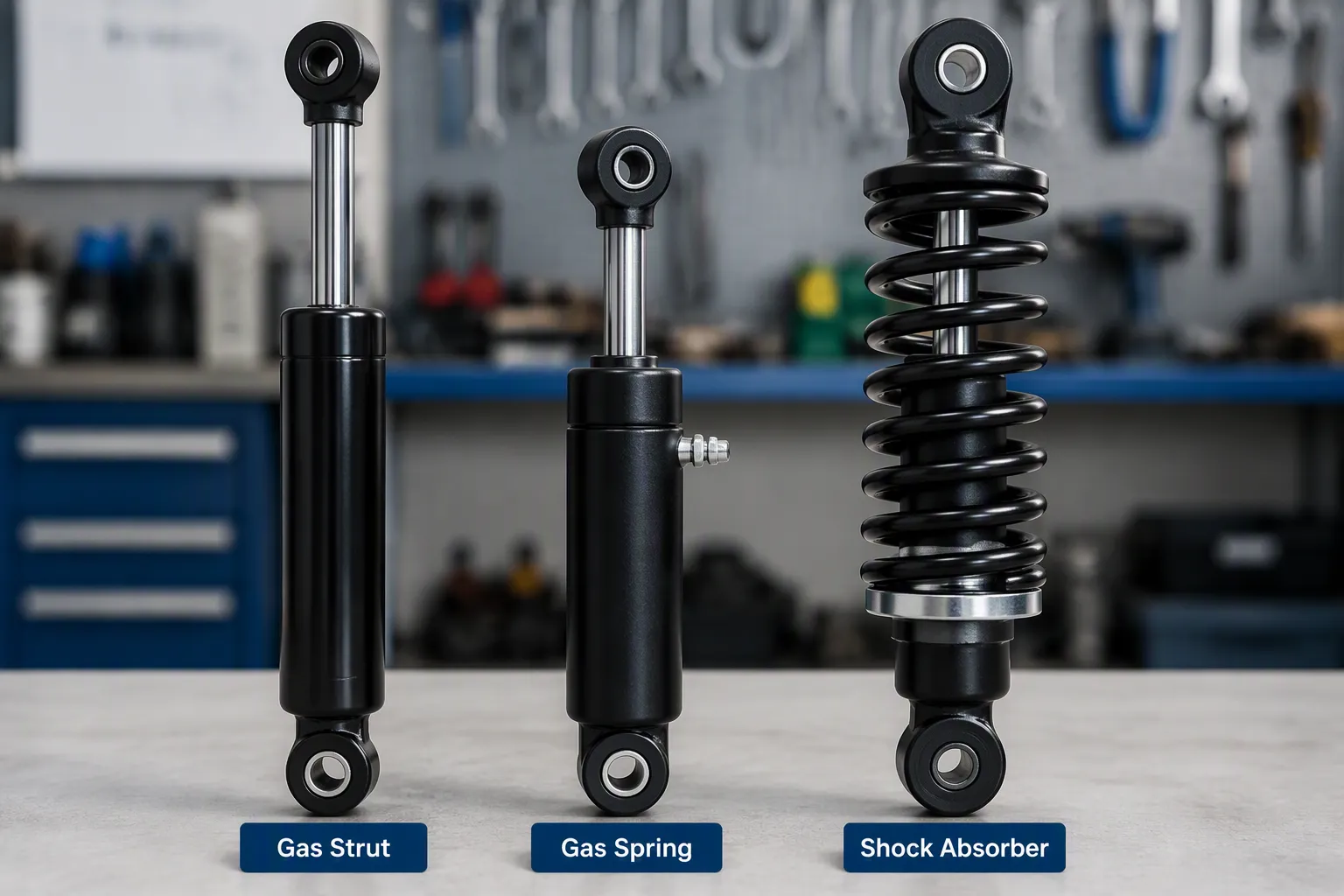
Gas struts provide lifting assistance with limited damping, gas springs store energy for lifting, pulling, or locking, and shock absorbers dissipate kinetic energy to control motion without lifting. All three share a sealed cylinder filled with pressurized nitrogen, which explains why buyers confuse them. The global gas spring market crossed USD 3.33 billion in 2025 and is estimated at USD 3.49 billion for 2026, reflecting how widely these devices are used. A gas filled strut, a gas spring, and a shock absorber each serve distinct mechanical roles. Understanding their individual mechanisms, energy handling, and load capacities helps you match the right device to your application.
Key Takeaways
Gas struts lift loads with limited damping; gas springs store energy; shock absorbers control motion without lifting.
Choose a device by your primary need: lifting assistance, energy storage, or motion control.
Verify force rating, stroke length, and mounting geometry to avoid common errors.
Shock absorbers use hydraulic fluid to dissipate heat; struts and springs use pressurized nitrogen.
What Is a Gas Strut?
A gas strut is a sealed cylinder that uses compressed nitrogen to assist lifting and holding. It is not a true damper. Damping appears only near the end of the stroke, where it slows the final travel and prevents a hard stop. This limited damping separates a gas filled strut from a shock absorber, which controls motion across the full stroke. (Note: In industrial purchasing, the terms "gas filled strut", "gas strut", and "gas spring" are often used interchangeably. At JUTENG, we categorize them based on their primary mechanical function to help you select the exact specification you need.)
How a Gas Strut Works
The rod slides into a cylinder filled with pressurized nitrogen. The gas pushes against the piston, and this pressure creates the lifting force. Force stays nearly constant through the stroke, unlike a coil spring that grows stiffer as it compresses. Engineers size the force from moment balance, often around 85 N per spring for a typical lid. A safety factor of 1.2 to 1.5 covers manufacturing tolerances, wear, and temperature swings. Stroke length comes from the geometry at fully closed and fully open positions, and adding 10–15 mm prevents bottoming out.
Temperature changes the internal pressure. Force shifts roughly 3.3–3.5% per 10°C, and total variation across the rated range can reach about 36%.
Parameter | Value / Effect |
|---|---|
Force change rate | ~3.3–3.5% per 10°C |
Total force variation | ~36% (-30°C to +80°C) |
Max continuous temp | 80°C |
Short-duration limit | 110°C for up to 1 hour |
"As a standard engineering practice, the maximum internal pressure of a gas spring must be carefully managed to avoid issues from overcharging, fluid ingress, high temperature, or a combination of these factors." — JUTENG Engineering Guidelines
Where Gas Struts Are Used
These devices appear on car hoods, trunk lids, and hatchbacks. They also support moving masses in kitchen cabinets, toolboxes, and display cases, where a typical static load reaches 200N with a safety factor of 1.5–2.0. Other settings include marine hatches, aerospace doors, medical equipment, ATM maintenance doors, kiosk service doors, and machine guards. Each application needs smooth load support without full shock control.
What Is a Gas Spring?
A gas spring stores elastic energy through compressed nitrogen. A coil spring stores energy through metal deformation instead. This difference shapes everything about how the two devices behave. The table below summarizes the main physical differences.
Aspect | Gas Spring | Coil Spring |
|---|---|---|
Internal contents | Pressurized nitrogen gas and oil | Mechanical coil only |
Force behavior | Near-constant through stroke (20–40% rise) | Rises linearly with deflection |
Damping | Internal oil charge slows the rod at stroke end | No damping; hits a mechanical limit |
Sealing | Sealed cylinder with seals | No seals; nothing to leak |
How a Gas Spring Works
The sealed cylinder holds nitrogen under pressure. Pushing the rod reduces the internal volume, and the pressure rises. This pressure generates the lifting force. The force curve is progressive rather than linear, because gas pressure climbs as volume drops and the rod cross-section displaces space inside the cylinder. Oil inside the unit adds damping, which slows the rod near full extension.
JUTENG manufactures a comprehensive lineup to meet diverse application needs. Our compressed gas springs handle lifting and supporting, while lockable gas springs hold any position with a high-precision locking mechanism. Dampers absorb speed and reduce noise, and traction gas springs work in reverse, extending when pulled. With force values spanning 5N to 3000N and strict ISO9001 certification, JUTENG's gas springs are engineered for durability, delivering a verified service life of 10,000 to 50,000+ double strokes under standard testing conditions.
Common Gas Spring Applications
Office chairs use gas springs for height adjustment, often around 100N for light-duty models and 200N–400N for medium-duty designs. Medical beds rely on lockable units to fix positions safely. Industrial equipment uses heavier ratings: 500N–800N for tool boxes and access panels, and 1000N–2000N for large machinery doors. Automotive applications include trunk lids and hoods.
What Are Shock Absorbers?
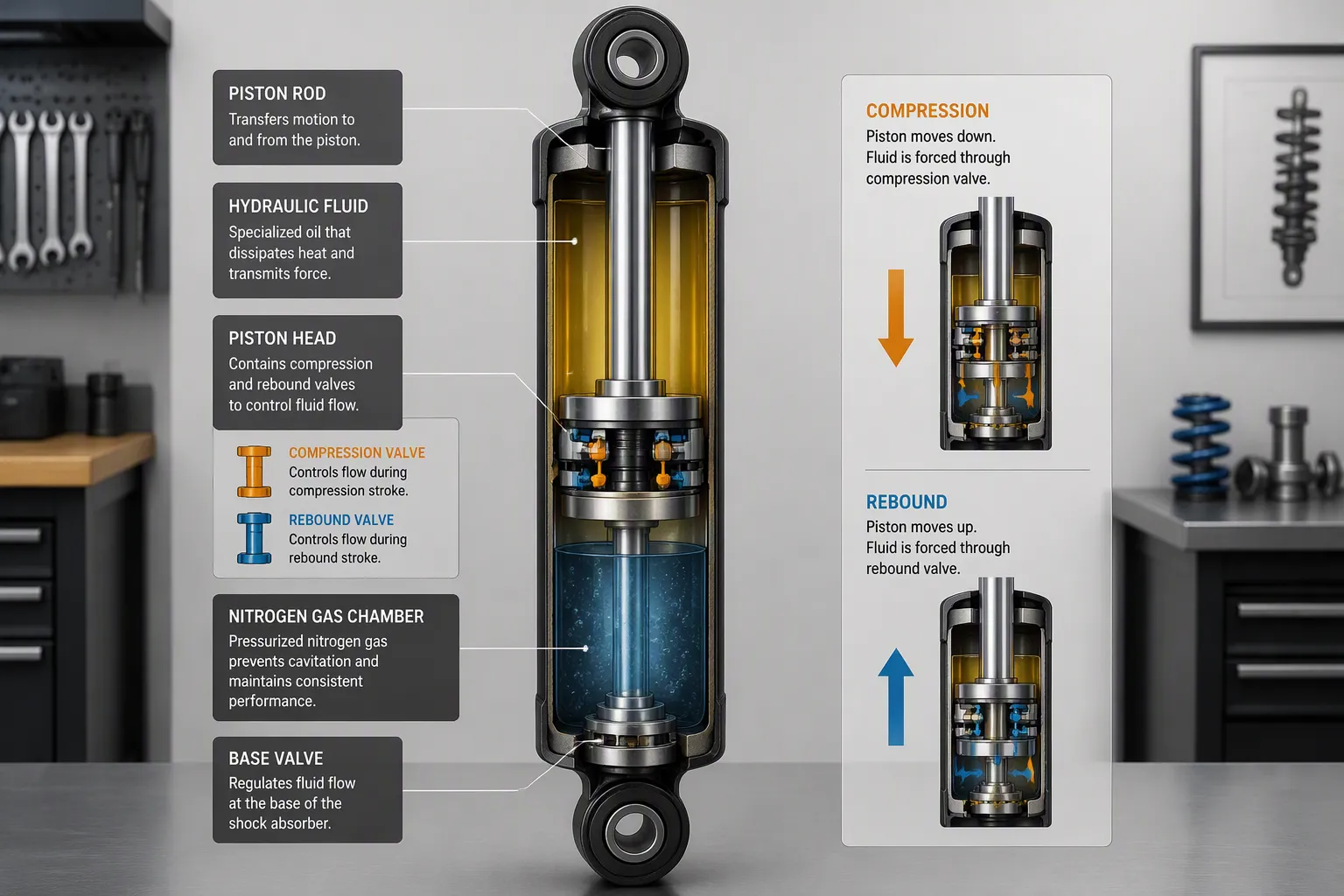
A gas shock absorber combines pressurized nitrogen with hydraulic fluid inside one sealed body. This dual medium gives gas shocks a higher load-carrying capacity than a strut or spring of similar size. The nitrogen pressurizes the oil and prevents foaming under rapid cycling. The oil does the actual work of resisting movement. Together they form a device built for motion control rather than load support.
How Shock Absorbers Work
The piston pushes oil through valves as the rod moves. Fluid pressure rises with piston speed, and the valving responds in stages:
At low pressure difference, fluid passes only through the fixed orifice, and damping force climbs steadily.
As pressure grows, shims deflect, the effective valve area opens non-linearly, and damping force growth tapers off.
Past a threshold, shims reach full deflection against a stop, flow area peaks, and damping force is set mainly by that maximum open area.
Engineers tune shim preload and stack stiffness to shape the force-velocity curve across low, mid, and high speed regions.
Valve Type | Location | Function | Stroke |
|---|---|---|---|
Compression Valves | Piston head | Control fluid flow across the piston; resist compression | Compression (jounce) |
Rebound Valves | Piston | Control flow during extension; smaller and stiffer to prevent over-extension | Rebound (extension) |
Base Valve | Bottom of shock (twin-tube) | Allow fluid flow between inner and outer cylinders | Compression |
The rebound valves are designed to offer significant resistance to fluid flow, which slows down the suspension's extension, preventing the tire from bouncing off the road and losing traction. The number, size, and stacking order of these discs are carefully tuned by engineers to deliver a specific "feel" during rebound.
The compression valves offer a lower resistance to this flow than the rebound valves. This allows the suspension to compress relatively easily to absorb a bump, providing a comfortable ride, while still controlling the motion.
This non-linear behavior means faster piston movement produces higher fluid pressure and stiffer valve response, adaptively balancing comfort and performance.
Typical Shock Absorber Applications
Vehicle suspension systems are the classic use case. A gas charged shock keeps tires planted by controlling rebound and compression. Doors use smaller units for smooth, controlled movement and quiet closing. Industrial machinery relies on them to absorb vibration and protect frames from repeated impact. In every case, the device manages energy rather than supplying lift.
Gas Filled Strut vs. Gas Spring vs. Shock Absorber
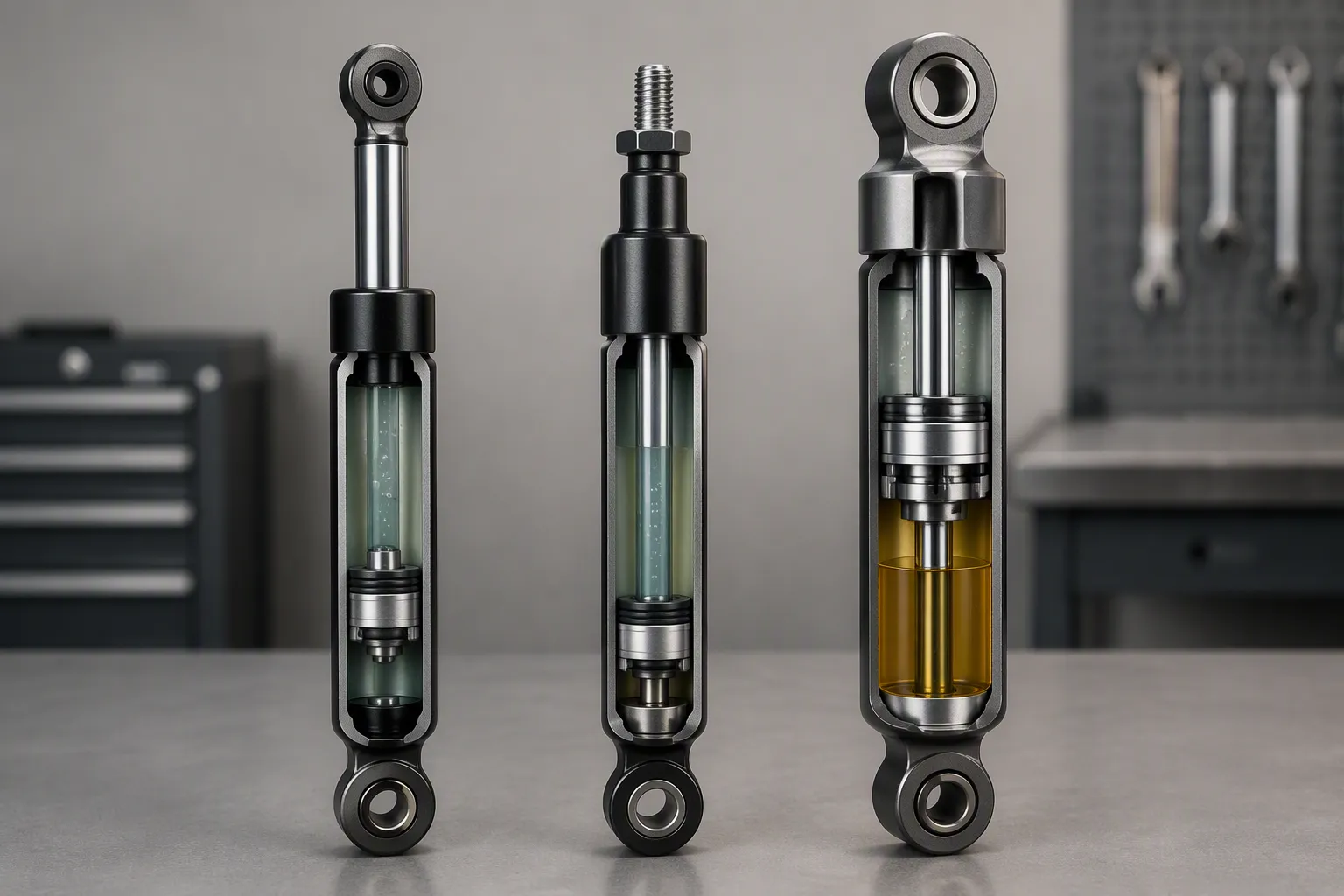
The three devices look alike on a shelf. Their internal chemistry tells a different story. A gas filled strut and a gas spring both rely on nitrogen as the elastic medium. A gas shock absorber adds hydraulic fluid to that same sealed body. This single design choice drives every difference in purpose, force direction, and load capacity.
Purpose and Force Direction
A gas strut exists to lift and hold a mass. A gas spring stores energy for lifting, pulling, or locking. A shock absorber controls motion and never supplies lift. Force direction follows purpose. Gas struts and standard gas springs push outward.
This pressurized gas forces the piston rod outward automatically. The outward force depends on the internal pressure and rod diameter.
Dampers behave differently. They resist movement instead of creating it.
A compression damper provides motion resistance when an external force pushes the piston rod into the cylinder tube. This setup prevents heavy lids from closing too quickly. An extension damper offers speed control while the piston rod pulls outward from the cylinder. ... Dampers do not push heavy loads upward.
Tension gas springs reverse the pattern entirely.
Unlike standard gas springs that push outward, a pull gas strut works by pulling the rod inward, enabling controlled retraction and tensioning in various mechanical applications. ... Pulling gas springs: shortest at rest, extends under force, generates inward pulling force. Compression gas spring: longest at rest, compresses under force, generates outward pushing force.
This distinction matters when comparing dampers vs. gas struts. A damper slows a door on its way down. A strut carries the door's weight on its way up.
Energy Handling and Load Capacity
Energy handling separates the three devices further. Gas struts and gas springs store potential energy in compressed nitrogen and release it as lifting force. Shock absorbers convert kinetic energy into heat through fluid friction. The table below summarizes the core differences.
Device | Purpose | Force Type | Energy Handling | Typical Load Capacity |
|---|---|---|---|---|
Gas strut | Lift and hold | Outward push | Stores and releases | Moderate |
Gas spring | Lift, pull, or lock | Outward or inward | Stores and releases | 5N–3000N rated force |
Shock absorber | Control motion | Resistance only | Dissipates as heat | Higher than a strut |
Gas shocks generally carry higher loads than gas struts of similar size. The hydraulic fluid shares the load with the nitrogen charge, and the valving spreads force across the full stroke. A gas charged shock in a vehicle suspension manages far greater impact energy than a hood strut ever sees.
Locking gas springs deserve special attention. Their holding capacity differs from their rated force. According to industry engineering standards and JUTENG's technical specifications, the maximum static load a locking gas spring can hold in its locked position is not a fixed value. It depends on the specific design, but most locking gas springs can support substantially more weight when locked than their rated extension force. Industrial models commonly hold about 2 to 3 times their extension force, and some specialized designs can support even higher loads. For exact maximum static load capacities, the manufacturer's specifications should be consulted. Damped gas springs sit between these categories. They store energy like a spring and slow the final travel like a damper, which suits lids and panels that need a soft finish.
How to Choose the Right Device
Selection Criteria by Application
Start with the primary need. A gas filled strut suits lifting assistance, gas springs suit energy storage or locking, and shock absorbers suit motion control. The table below shows how load, stroke, and speed priorities shift between a strut and a gas shock.
Parameter | Gas strut | Gas shock / damper |
|---|---|---|
Primary role | Supports and counterbalances moving masses | Controls speed and dampens oscillations |
Load | Force rating should match or slightly exceed the load | Provides no lifting force; resists motion |
Stroke | Stroke and extended/compressed dimensions must fit the motion range | Stroke matters, but damping performance leads |
Speed | Oil and piston openings smooth the movement | Orifice size and fluid viscosity tune the damping |
Verify several values before purchase. These include force rating, stroke length, extended length, compressed length, durability, mounting position, and environmental conditions. The mounting angle changes the effective force, so confirm the geometry first. High temperatures or aggressive atmospheres may call for protective coatings or special seals. For custom work, JUTENG's OEM/ODM support is readily available. Our in-house technical team can specify the right unit, run computer-based simulations (CATIA/SolidWorks), and adjust damping, forces, gas pressures, or oils. Custom parts can ship in as little as 3–4 weeks.
Common Mistakes to Avoid
Undersizing the bore ranks among the most frequent errors. A bore that is too small forces the unit to run at high pressure. Ignoring the reduced rod-side force when retracted is another common slip. Poor alignment wears the seal and rod, and skipping friction and manufacturing tolerances throws off the force estimate.
Installation errors cause many premature failures. Overtightening the top nut far beyond the 41–68 Nm specification can break the stem or loosen the piston rod nut. Using pliers on the chromium rod scratches the surface, and the damaged area tears the seal once compressed. Replacing only one unit per axle overloads the new part. Old mounting kits and worn protection kits should be replaced alongside the new unit. Damped gas springs and other types share these rules, and their ideal applications reward careful matching.
A gas filled strut lifts and holds a load with limited damping. Gas springs store and release energy for lifting or locking. Shock absorbers dampen motion without providing lift. These roles rarely overlap in practice.
Three factors guide your choice: purpose, force type, and energy handling. Gas struts push outward to support weight. Gas shocks resist movement instead. Damped gas springs sit between the two, storing energy and slowing the final travel.
Identify the application's primary need first. Then verify force ratings, travel length, and mounting points before you buy. That sequence prevents most sizing errors.
FAQ
What is the main difference between a gas strut and a gas spring?
A gas strut provides lifting assistance with limited damping near the end of its stroke. A gas spring stores elastic energy through compressed nitrogen for lifting, pulling, or locking. Both use nitrogen as the elastic medium. The gas spring category includes compressed, lockable, damper, and traction types.
Can I use a shock absorber in place of a gas strut?
No. A shock absorber controls motion and dissipates kinetic energy as heat. It provides no lifting force. A gas strut pushes outward to support a load. These roles rarely overlap. Using the wrong device risks poor performance or damage to the application.
How do I tell these devices apart visually?
All three share a sealed cylinder with pressurized nitrogen. A gas shock absorber adds hydraulic fluid inside the same body. This dual medium gives gas shocks higher load-carrying capacity. The difference lies in internal chemistry, not external appearance. Manufacturers label each unit with its force rating and type.
When should I choose dampers vs. gas struts?
Choose a gas strut when the application needs lifting assistance and load support. Choose a damper when the goal is speed control, noise reduction, or soft closing. Dampers resist movement without pushing loads upward. Gas springs handle energy storage or locking tasks. Match the device to the primary need first.
What should I verify before buying gas springs?
Check force rating, stroke length, extended length, compressed length, and mounting position. Confirm the geometry because mounting angle changes effective force. Verify durability and environmental conditions. For custom requirements, OEM/ODM support and design assistance are available from manufacturers like JUTENG.
Need a Custom Gas Filled Strut Solution?
Choosing the right gas filled strut or gas spring is critical to your product's performance and safety. At ChangZhou Juteng Gas Spring Co., Ltd., we offer more than just standard parts. Our in-house engineering team provides:
Free 3D Modeling & Simulation: Supporting CATIA and SolidWorks to ensure perfect fit and function.
Rapid Prototyping: In-house sample creation and test equipment for minimal development time.
Flexible OEM/ODM Services: Tailored force ratings (5N–3000N), stroke lengths, and end fittings to match your exact application.
Contact JUTENG today for a free technical consultation, force calculation support, or to request a sample. Let our 15+ years of expertise power your next project. Get in touch with our engineering team.
Recent News
1.Tension Gas Springs: A Complete Selection Guide
2026-09-072.Lockable Gas Spring Applications for Bus Seats
2026-08-293.Single or Dual Gas Strut Setups Which Is Right for Your Application
2026-07-224.Main Difference Between a Gas Strut and a Gas Damper
2026-08-045.304 stainless steel gas spring apply to cabinet
2026-08-156.Which Gas Spring Performs Better Stainless-steel or Regular
2026-07-28