




Understanding Gas Struts-A Comprehensive Guide to Different Force Ratings and Their Applications
A gas strut that is too weak lets a tailgate settle onto your head; one that is too strong fights you every time you try to close it. Most complaints of that kind get blamed on the hinge, yet the usual cause is a strut picked by eye instead of by specification. Gas struts, also called gas springs or gas shocks, turn up in automotive bodies, furniture, medical equipment, aerospace assemblies, and industrial machinery, and the spread of available force ratings is wider than most buyers expect: catalog options run from 40 N to 1200 N and custom fills go beyond that.
This guide sets out the main types of gas struts, explains what each force band is actually good for, and lists the four measurements you need in hand before you can order anything.

Key Takeaways
The types of gas struts are normally classified four ways: by force rating, by function, by application, and by mounting configuration. A real specification draws one answer from each.
Light-duty struts (40–200 N) suit laptop stands, monitor arms, and small cabinet doors; medium-duty (300–500 N) covers vehicle hoods and trunk lids; heavy-duty (600–800 N) handles tailgates, machine covers, and hospital beds; 1200 N and above serves construction equipment and aerospace panels.
Extension force, stroke, extended length, and compressed length are the four numbers a supplier needs. Mounting angle changes the effective force, so the same strut can behave differently in two installations.
A gas strut is a wear item with a service life counted in cycles rather than a permanent fitting. Plan on replacement somewhere between five and ten years of normal use.
What Are Gas Struts?
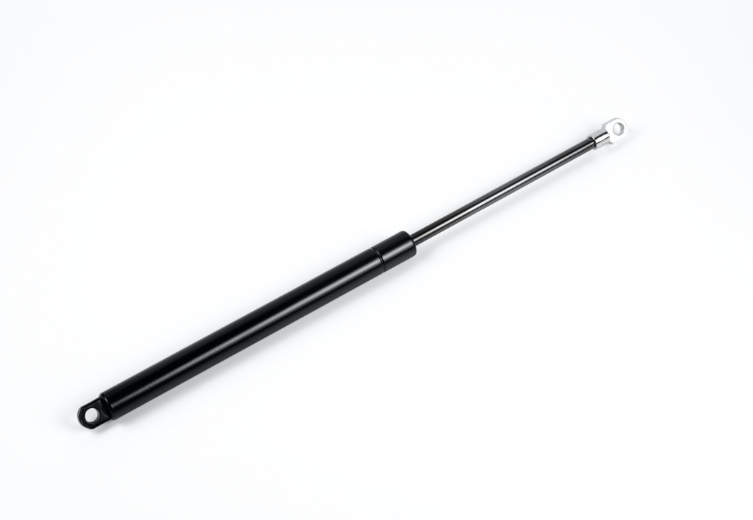
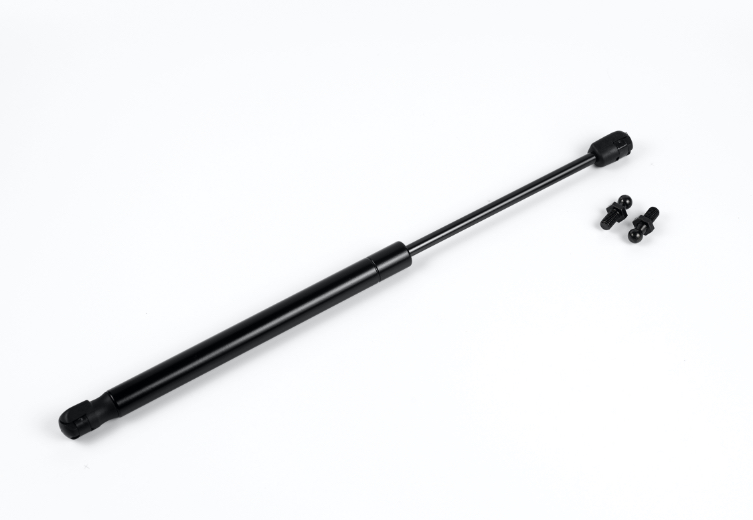
A gas strut is a sealed pressure cylinder with a piston rod that extends and retracts through a sealing guide. Because the gas volume is trapped, pushing the rod inward reduces the free volume and raises the internal pressure, and that pressure acting on the rod cross-section is what produces the extension force. The force is quoted in newtons (N), and it is the single number that decides whether a given strut can lift a given lid.
The result is a component that raises heavy covers, holds doors open at a chosen angle, and balances equipment so it moves under control. It is not a spring in the coil sense. The force curve across the stroke is much flatter, which is why a correctly sized strut feels consistent from the first centimeter of travel to the last, and why the difference between types of gas struts shows up in behavior rather than only in the force number.
Keeping the unit straight helps when you compare quotes. One newton is the force that accelerates a one-kilogram mass at one meter per second squared, as set out in the SI definition of the newton as a unit of force, so a 100 N strut supports roughly 10 kg when acting vertically.
Three construction details matter more than most buyers realize. The gas is normally nitrogen, which is non-flammable and makes up about 75% of the air we breathe; a small charge of flame-retardant oil lubricates the seals and supplies part of the damping. The tube is closed by plastic deformation during production, so a strut cannot be opened or re-gassed: it is replaced, not repaired. And force rises as the rod goes in, though the rise is held to a modest ratio on a well-specified unit, typically within 1:1.2 from fully extended to fully compressed.
Types of Gas Struts: A Comprehensive Classification
The types of gas struts can be grouped in four ways. Each grouping answers a different question, and the useful specification is the combination of one answer from each group.
1. Classification by Force Rating
Force band is the first filter, because it decides what the strut can physically move. The four bands below are the ones used throughout this guide and in most supplier catalogs:
Light-duty (40–200 N): small, low-force units for laptop stands, monitor arms, and small cabinet doors where the load is measured in a few kilograms.
Medium-duty (300–500 N): the working band for vehicle hoods, trunk lids, machine access panels, and medium-weight furniture.
Heavy-duty (600–800 N): large vehicle tailgates, industrial equipment covers, and medical or hospital beds.
Super heavy-duty (1200 N and above): construction equipment panels, aerospace components, and large storage containers.
2. Classification by Function
Function describes what the strut does beyond holding a load up. Four behaviors cover most of the market, and the choice between them is what separates the practical types of gas struts in day-to-day use:
Standard struts provide basic lift and support with no user control. The rod extends under pressure and the load closes it again.
Lockable struts add a release mechanism so the rod can be locked at chosen positions, which matters for height-adjustable desks, medical furniture, and chairs that must hold a setting. See the lockable gas spring range.
Damping struts meter oil through a restricted passage to slow the final part of the stroke, so a lid arrives at its stop quietly instead of slamming. See the damper range.
Traction struts work in the opposite direction: the rod is pulled in rather than pushed out, which suits counterbalancing and closing assistance. See the traction gas spring range.
3. Classification by Application
Application grouping reflects the environment and the duty cycle as much as the force. The same nominal force can need very different seals, coatings, and end fittings depending on where it works:
Automotive struts for hoods, trunk lids, and tailgates, usually specified with ball-joint ends for quick assembly and with corrosion protection for road spray.
Furniture struts for cabinet doors, wall beds, and adjustable seating, where quiet operation and a clean finish matter as much as the force. See the furniture gas spring range.
Industrial struts for machine covers, access panels, and heavy guarding, where the stroke is long and the environment may include dust, coolant, or washdown.
Medical struts for hospital beds, examination tables, and rehabilitation equipment, where controlled motion and lockable positioning are typically mandatory rather than optional.
4. Classification by Mounting Configuration
The end fitting decides how the strut attaches and how much misalignment it can absorb. It is the part most often left off a first enquiry, and it is the part that most often delays a build:
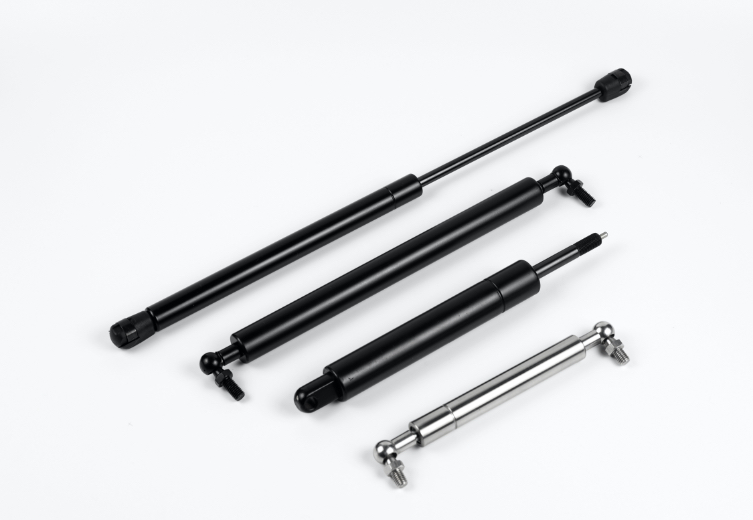
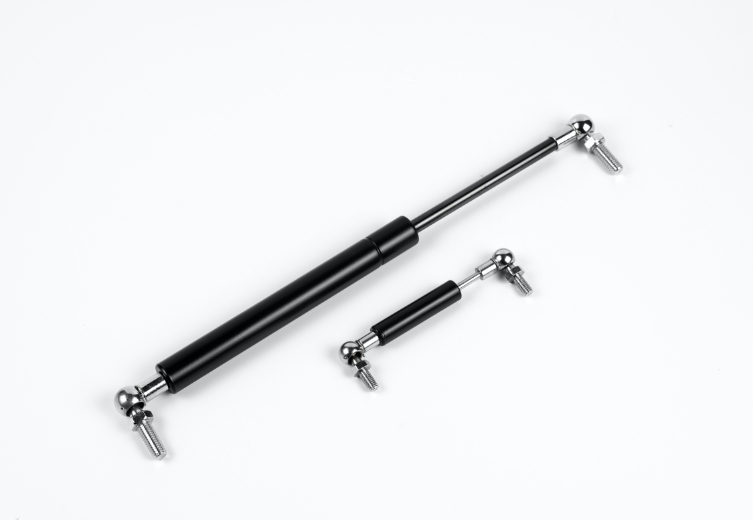
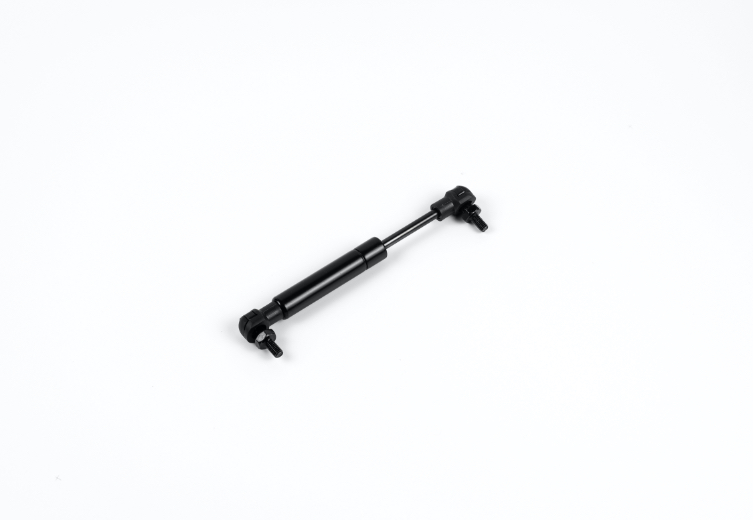
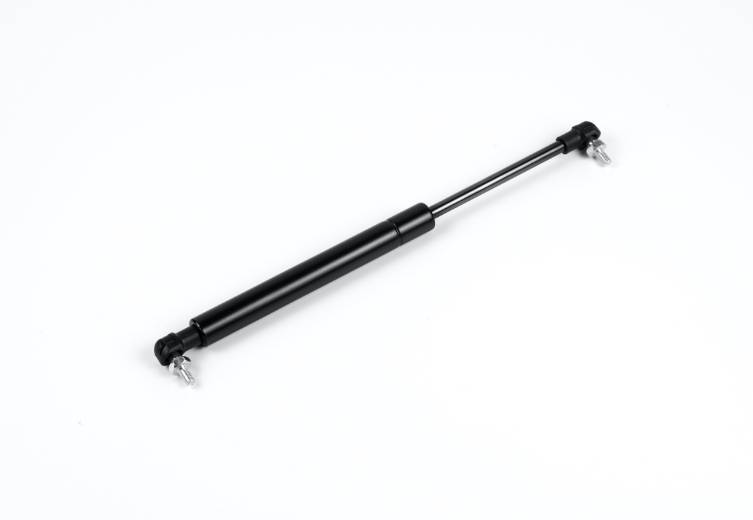
Ball joint ends use a ball-and-socket connection that tolerates multi-angle installation and slight frame flex, which is why they dominate automotive and furniture applications.
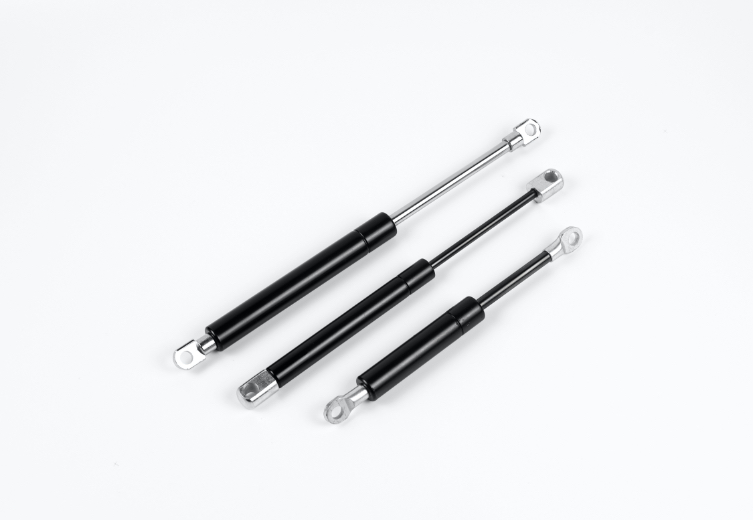
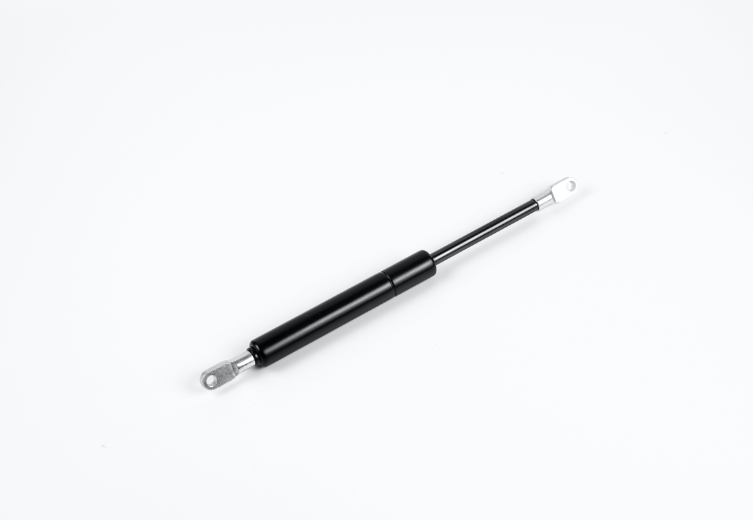
Eyelet ends use a looped end for a pin or bolt, giving a stiffer, more precise pivot for industrial panels and machinery.
Custom fittings cover threaded ends, brackets, and application-specific interfaces where a standard ball or eye will not fit the existing mounting point.
Performance Parameters That Decide Fit
Whatever the classification, the same handful of numbers decides whether a strut will work. Five parameters cover almost every enquiry, and the typical ranges below come from standard lift-spring tables rather than from a single application. A gas strut force rating quoted without its test conditions is only a rough guide, which is why the first row of the table lists them.
| Parameter | What it defines | Typical range |
|---|---|---|
| Extension force (F1) | Lift or support capacity, measured with the rod extended 5 mm and read about 3 seconds after the rod stops moving | 50–800 N in the 15/6 and 18/8 lift series; custom fills up to 3000 N |
| Stroke | Travel of the piston rod from closed to fully open | 20–290 mm in the standard tables |
| Extended length | Center-to-center length with the rod fully out | 91–700 mm in the standard tables |
| Compressed length | Center-to-center length with the rod fully in; equals extended length minus stroke | Derived from the two values above |
| Durability | Ability to survive repeated cycles plus heat, moisture, and salt exposure | Cycle life and salt-spray resistance are quoted per series; test methods are covered by the standard practice for salt spray corrosion testing |
Force measurement itself is worth a note, because it explains why two suppliers can quote different numbers for a strut that looks identical. F1 is read at a defined rod position, at a defined approach speed, and at a defined temperature, so a value quoted without those conditions is only a rough guide.
Applications of Gas Struts by Force Rating
The clearest way to compare types of gas struts is to work outward from the force band to the jobs it handles. The four bands below run from a monitor arm to a construction machine, and each one carries a different set of mechanical demands.
Gas Struts 40 N to 200 N (Light-Duty Applications)
The compressed gas spring range covers the 40 N, 50 N, 80 N, 150 N, and 200 N sizes that make up this band. These are small, light units built for accurate load capacity and stable output, where the goal is to extend service life rather than to move mass. They are the right choice whenever the least possible lift power is enough.
Typical uses include laptop stands and monitor arms, lightweight cabinet doors and lids, and minor furniture parts such as reclining chair mechanisms. In this band, oversizing is the common mistake: a 200 N strut on a 3 kg flap will push the flap open on its own and feel stiff to close. The published stroke range for the smallest series runs to 150 mm, which is ample for a cabinet lid but far too short for a bed platform.
Gas Struts 300 N to 500 N (Medium-Duty Applications)
The 300 N, 350 N, 400 N, and 500 N sizes sit in the auto parts gas spring range. This band combines a strong rod with enough travel to suit larger panels, which is what makes it the default for anything a person lifts by hand several times a day.
Common applications are vehicle hoods and trunk lids, access panels on industrial machinery, and medium-weight furniture such as sofa beds and storage benches. The band is also where mounting geometry starts to matter most: a strut that holds a hood at 60 degrees may be marginal at 30 degrees, because the effective force depends on the angle between the rod and the load.
Gas Struts 600 N to 800 N (Heavy-Duty Applications)
The 600 N, 650 N, 700 N, and 800 N sizes are listed under the industrial gas spring range. A 650 N strut is a good reference point for the band: moderate load capacity, adaptive support across a range of equipment, and cushioning that absorbs impact and cuts vibration and noise. The published operating range for these units is -40 °C to +80 °C, and lengths are customizable, with ball-joint and eyelet ends both available.
Applications include heavy vehicle tailgates and hatches, covers on large industrial equipment, and medical or hospital beds. At this force level the strut is carrying real weight, so the mounting brackets and the frame around them need to be checked as carefully as the strut itself, and the required force rating for a given lid is usually established by measurement on a prototype rather than by estimation.
1200 N Gas Struts (Super Heavy-Duty Applications)
At 1200 N and above, the types of gas struts in play are high-load units intended for extreme loading and working conditions. The rod and tube are larger, the seals are specified for higher pressure, and the end fittings are usually bespoke rather than catalog parts.
Applications include access panels on construction equipment, aerospace components, and large storage containers and industrial machinery. In this band, a strut is a structural element rather than an accessory, and a load calculation is not optional.
Need a strut matched to a specific load, stroke, and mounting angle? Send the four key numbers and get a quotation back.
Get a QuoteHow to Pick the Correct Gas Strut
Selection is mostly bookkeeping. Five checks catch nearly every sizing error before it becomes a returned order:
Weigh the load, then add margin. Determine the weight of the object being lifted. A strut should be specified slightly above the load it has to support, because gas pressure drops with temperature and with time.
Check the mounting position and angle. The effective force is the strut force multiplied by the sine of the angle between the rod axis and the load direction. Two identical struts on two different hinge geometries will not feel the same.
Confirm stroke and both lengths. Verify that the stroke, the extended length, and the compressed length all fit the space you have. A strut that bottoms out before the lid closes will bend the mounting.
Match the environment. For heat, humidity, or aggressive atmospheres, specify a coated tube or a stainless option. Stainless bodies are the usual answer for washdown and marine work.
Fix the end fittings early. Ball joint, eyelet, or custom: the choice affects both the pivot stiffness and the available travel.
One point on load safety is worth stating plainly. Any strut-assisted cover is a stored-energy device, and a strut that fails while a person is underneath is a hazard rather than an inconvenience. General requirements for securing and handling materials are described in general material handling safety requirements, and for storage furniture specifically, tip-over resistance is addressed by the clothing storage unit safety specification. Neither replaces a load calculation, but both point at the same conclusion: the strut is part of the safety envelope, not an afterthought.
Advantages of a Well-Specified Strut
The benefits of getting the specification right are practical rather than promotional, and they apply equally across the types of gas struts described above:
Controlled motion. A strut takes over the lifting duty from the hinge, so the load moves at a steady pace instead of dropping or slamming, and the hinge and latch wear far more slowly.
Safety. A correctly rated strut prevents sudden falls and slams, protecting both the operator and the equipment underneath.
Service life. High-strength tube, a proper sealing system, and a corrosion-resistant finish are what carry a strut through frequent use. Cycle life is the number to ask for, not a general claim about durability: the light-duty series is rated by the supplier at more than 100,000 cycles, which is the kind of figure worth comparing directly.
Versatility. Force, stroke, and end fitting can all be varied, which is why a single strut architecture can serve a monitor arm and a tailgate. It is also why an off-the-shelf unit rarely fits a new design without at least one change.
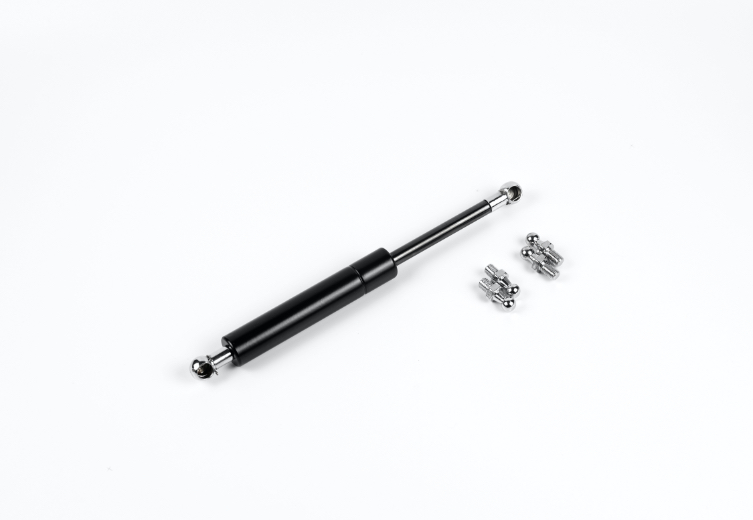
YQ6/15-1 Lift Gas Spring
Furniture series: 15 mm cylinder, 6 mm rod, 50–300 N, strokes to 150 mm.
View Product
YQ8/18-1 Lift Gas Spring
Auto parts series: 18/19 mm cylinder, 8 mm rod, 80–800 N, strokes to 290 mm.
View Product
YQ12/25-3 Lift Gas Spring
Industry series: larger bore for machine covers and heavy access panels.
View ProductAlready have the force, stroke, and end-fitting requirements? JuTeng can quote against your drawing or sample.
Contact UsConclusion
Gas struts add function, safety, and a measurable reduction in effort to a very wide range of products, and the differences between them come down to four decisions: force band, function, application environment, and mounting configuration. Get those four right and a 40 N strut for a light cabinet lid and a 1200 N strut for a construction panel are the same problem solved twice. Get them wrong and no amount of quality in the component will make the lid close properly.
If you are looking for a dependable gas struts manufacturer, Changzhou JuTeng Gas Spring covers the 40 N to 1200 N range, builds one-off struts to a specified force, length, and mounting configuration, and runs production against a documented quality management system rather than against per-order improvisation. The company states a five-year warranty on its struts and keeps technical support available for selection, installation, and troubleshooting questions, which is worth more than a low unit price when a first design does not behave as predicted. Sending the load, the stroke, and the mounting dimensions is usually enough to get a quotation started.
FAQ about Gas Struts
1. What does a gas strut do?
A gas strut, also called a gas spring, provides support and cushioning. It helps open and close heavy objects with less effort and reduces vibration and impact in the mechanism it is fitted to.
2. How do I know what size gas strut I need?
Start with the weight of the object being supported, then check the travel distance needed and the installation space available. From there, compare load capacity, stroke length, mounting type, and operating environment against the catalog tables, or send those numbers to a supplier for a recommendation.
3. How often do gas struts need to be replaced, and how do I know when one is failing?
Replacement typically falls somewhere between five and ten years, depending on usage frequency, load, and operating conditions. Visible oil leakage, weak or uneven support, slow or jerky movement, and unusual noise are the usual signs that a strut has reached the end of its service life.
4. Are gas struts easy to replace?
For someone with basic mechanical skills, replacement is usually straightforward: the strut is a sealed unit held by two mounting points, so it is removed and refitted rather than repaired. Complex installations with locking mechanisms or multiple struts per panel may call for professional help.
5. Do gas struts need a wheel alignment afterwards, and what does a failing one sound like?
Not the gas struts described here. A wheel alignment is recommended after replacing a suspension strut, which is a different component that carries spring and damper duty in a vehicle's suspension, and the clunking, rattling, or squeaking associated with a bad strut also refers to that suspension part. A gas strut that is failing is more likely to show up as a sagging lid, an oil film on the rod, or a cover that will not stay open.
6. What are the main types of gas struts?
The main types of gas struts fall into four groups: by force rating (light-duty 40–200 N, medium-duty 300–500 N, heavy-duty 600–800 N, super heavy-duty 1200 N and above), by function (standard, lockable, damping, traction), by application (automotive, furniture, industrial, medical), and by mounting configuration (ball joint, eyelet, custom fittings). Most specifications combine one choice from each group.