





Gas Spring vs. Damper: Core Differences & Selection Tips
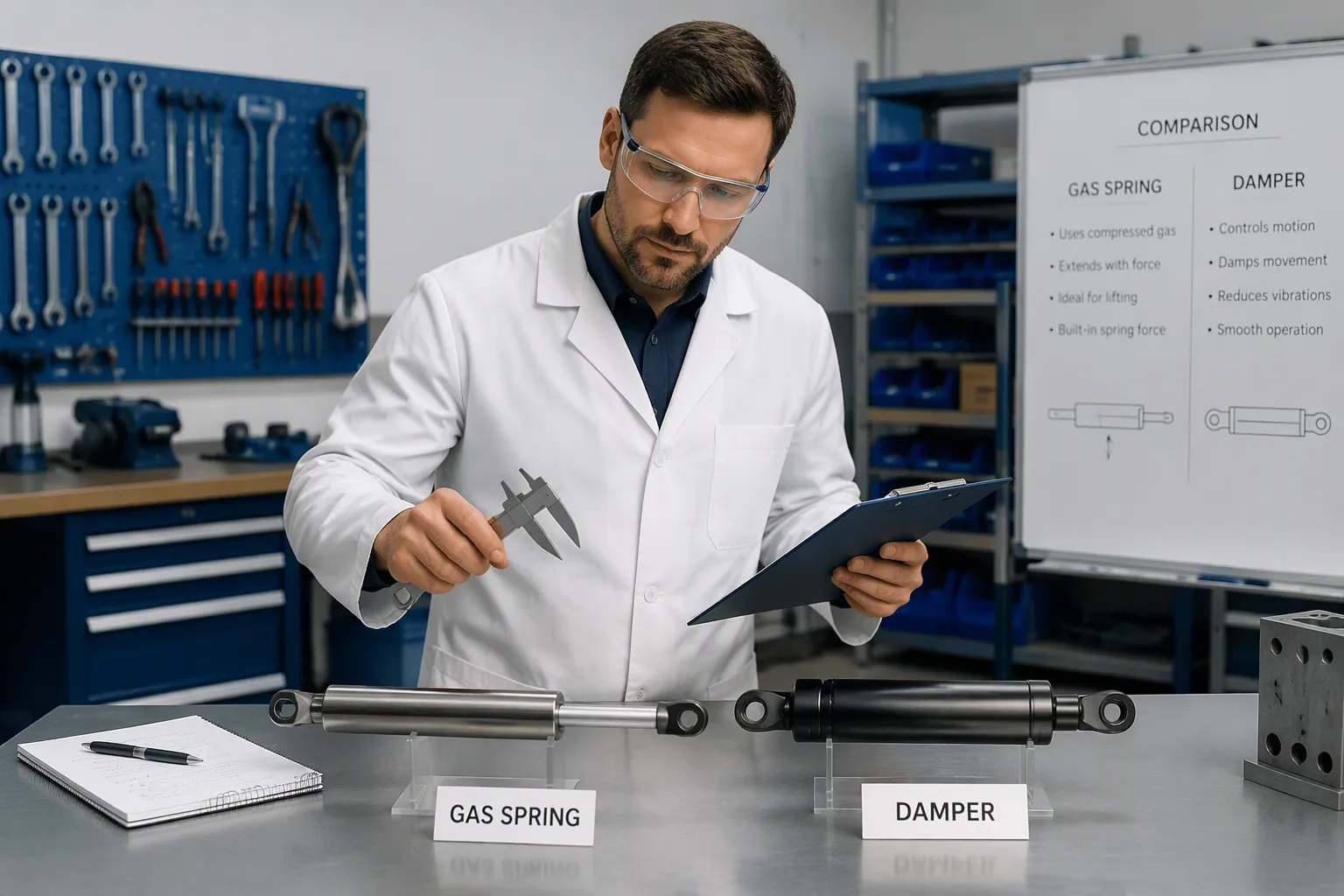
Although gas springs and dampers often look similar and may both contain gas or fluid, they serve fundamentally different mechanical purposes. A gas spring generates the active force required to move or hold an object, whereas a damper provides a reactionary force designed solely to control and slow down motion. Understanding this core distinction is critical for engineers and designers to select the right component for their applications. Let's explore how each device works and which applications suit them best.
Key Takeaways
A gas spring creates force to lift or hold objects. A damper creates resistance to slow motion.
Choose a gas spring for lifting or positioning tasks. Choose a damper for controlled deceleration.
Damped gas springs combine both functions. They lift loads and soften the end of the stroke.
Match the device to the motion needed. This simple check prevents most selection errors.
Avoid common mistakes like using a damper where lifting force is required.
Gas Spring vs. Damper: The Core Difference
Force vs. Reactionary Force
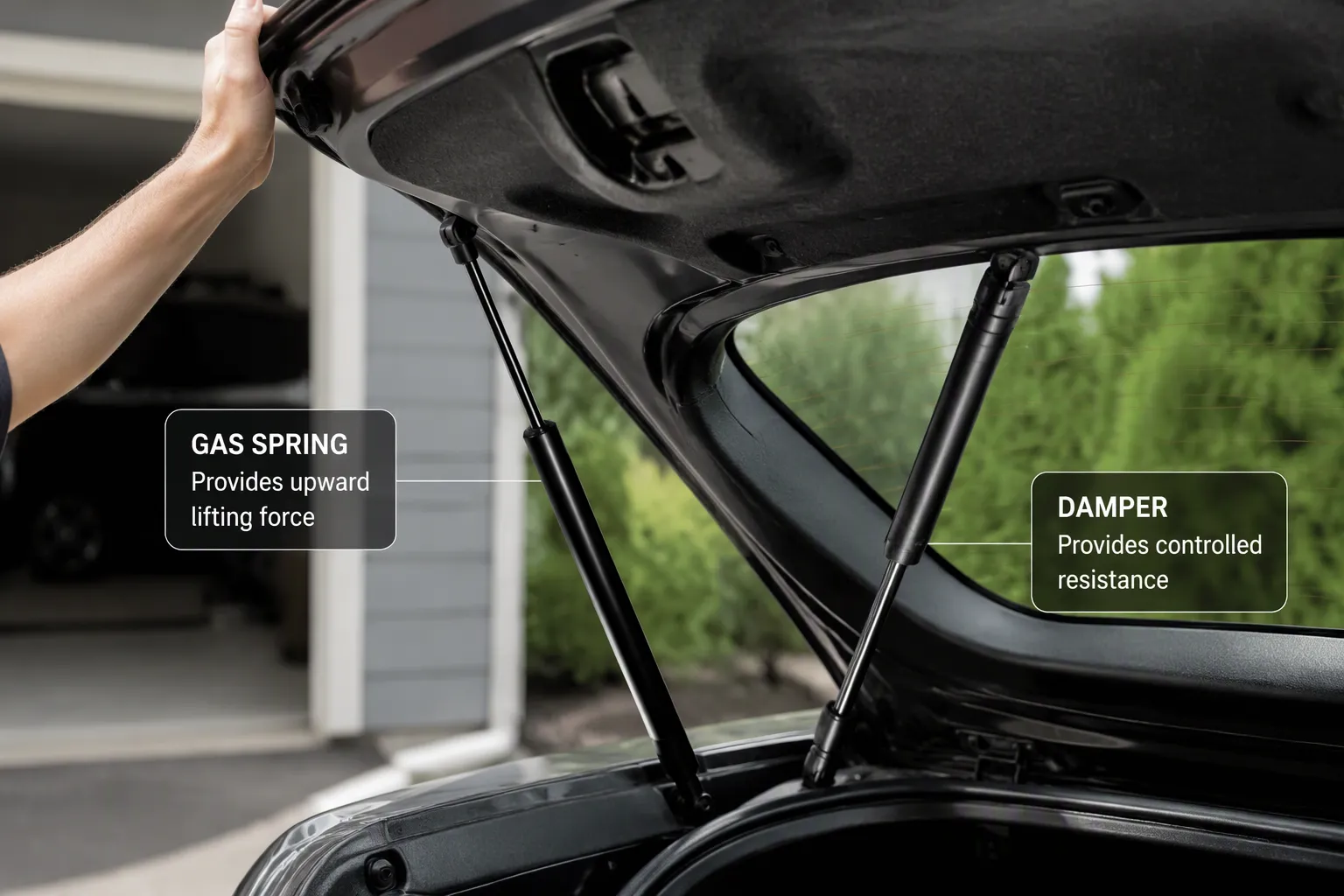
A gas spring generates force. It lifts, lowers, supports, or positions an object. A damper does not generate force. It provides only a reactionary force to slow motion. The two devices serve opposite roles in a mechanical system. This distinction sits at the heart of any gas spring vs. damper comparison.
The table below summarizes the contrast.
Attribute | Gas Springs | Dampers |
|---|---|---|
Force generation | Actively generate a force to provide lift assistance (e.g., pushing a lid up) | Generate no force or lift assistance |
Reactionary force | Provide some damping effect but are not true dampers | Provide only a reactionary/resistance force to slow motion, proportional to the object's velocity, always staying in contact with the moving object (e.g., preventing a lid from lowering quickly) |
A gas spring acts as an energy source. It pushes a lid up and holds it there. A damper acts as an energy absorber. Its resistance grows with the speed of the moving object. A fast-moving lid meets strong resistance. A slow-moving lid meets weak resistance. This behavior follows the object's velocity, not its position. The damper stays in contact with that object throughout the stroke. It never lifts anything on its own. It cannot hold a position either. Its only job is to control speed. Remove the damper and the lid still opens and closes. Remove the gas spring and the lid has no help at all.
A Simple Everyday Example
Consider a car trunk lid. A gas spring pushes the lid open. The force must match the lid weight. A 10–18 kg lid typically needs 350–600 N per strut, based on two struts supporting the lid. An 18–30 kg lid calls for 600–900 N per strut. A 500N gas strut, common in car trunk lids, provides roughly 112 lbs of force. A 700N gas strut serves heavier sedan and SUV trunk lids at roughly 157 lbs. Pick a strut with too little force and the lid will not stay open. Pick one with too much force and the lid will fly up too fast. A trunk lid is heavy, so the strut force matters a great deal. The gas spring does the lifting work in every case.
Now consider a cabinet door closer. This damper prevents the door from slamming shut. It supplies no opening force. It only resists the closing motion and brings the door to a soft stop. The door still needs a handle and a push to close. The damper simply removes the bang at the end. A cabinet door without a closer still works. It just closes hard. The closer only shapes the final motion.
One source of confusion remains. Gas springs with built-in damping are often called gas dampers or gas shocks. These products combine both functions. They lift an object and soften the end of the stroke. The label does not change the underlying physics. A true damper still provides reactionary force only. A damped gas spring still generates lifting force first. The gas spring vs. damper question therefore has a practical answer. Check whether the device must create motion or only control it. That single check prevents most selection errors.
What Is a Damper?
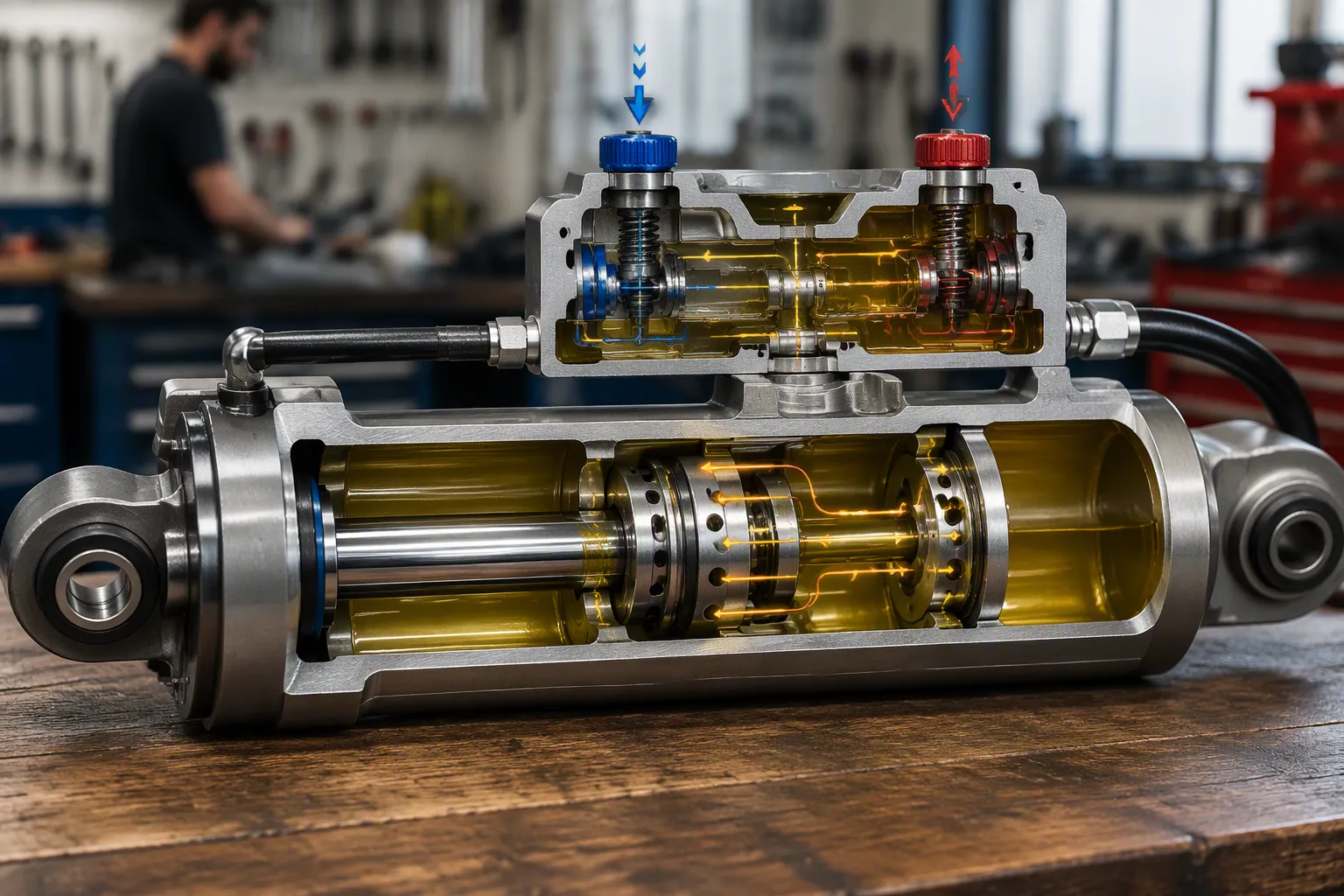
A damper is a motion-control device. It absorbs energy and slows a moving mass. It does not push, lift, or hold anything. High-quality hydraulic dampers, such as those engineered by JUTENG, often use specialized fluids like food-safe silicone oil within a closed housing. This fluid flows through small internal channels and precision valves. The fluid's viscosity, combined with the channel's cross-section design, creates the friction that reduces speed. The piston rod moves, fluid is pressed through bores in the piston system, and the damping force comes directly from the fluid's resistance to that flow. Therefore, damping force depends on piston speed, not on position.
How a Damper Works
Pull and push forces can be set independently in advanced models. The internal valve system splits into hydraulically separated control chambers. Each chamber controls a different aspect of the damping force. This design scales the push-pull force ratio without adding proportional complexity, allowing for precise, independent external adjustment of in-and-out speeds.
"Precision dampers allow for independent adjustment of extension and compression speeds, ensuring smooth operation regardless of the load's direction." — JUTENG Engineering Standards for Motion Control.
Performance and Common Uses
Hydraulic dampers deliver controlled deceleration. They prevent sudden drops, slamming, and uncontrolled movement. The result is lower impact, vibration, noise, and component wear. Resistance rises with velocity, so a fast-moving lid meets strong resistance and a slow one meets weak resistance. This produces gradual, predictable deceleration instead of an abrupt halt.
Smooth, gradual deceleration rather than abrupt stopping
Reduced slam impact, noise, and wear
High adjustability through valves and orifices
These traits suit closing applications above all. Rotary viscous dampers bring gentle closing to glove box lids, refrigerator doors, and cabinet drawers. Other common uses include automotive console compartments, medical device covers, home appliance doors, vending machine mechanisms, and industrial control panel access points. In each case the damper shapes the final motion and removes the bang at the end of the stroke.
What Is a Gas Spring?
How a Gas Spring Works
A compressed gas spring is a hydropneumatic element. It consists of a pressure tube, a piston rod, and a piston unit. The tube holds pressurized nitrogen. Nitrogen is safe and non-flammable, which makes it a practical choice for sealed components. Purity matters significantly for longevity. At JUTENG, we fill our gas spring tubes with 99.999% high-purity nitrogen to protect internal components, prevent oxidation, and ensure stable performance over tens of thousands of cycles. Furthermore, our products undergo rigorous fatigue and salt spray testing, and are available in durable carbon steel or corrosion-resistant stainless steel (304/316) for harsh environments.
JUTENG manufactures a comprehensive range of these products. Our lineup covers compressed gas springs, lockable gas springs, hydraulic dampers, and traction gas springs. Lockable models feature a high-precision locking mechanism that holds any position securely. Their force adjusts from 25N to 2600N, and a built-in hydraulic damping system smooths the movement for premium applications.
Traction gas springs work in reverse. They rest retracted. A pulling force extends them, and they retract again once released. This behavior suits applications that need controlled pulling rather than pushing.
Performance and Common Uses
The two spring types differ in force direction and rest position. The table below sets out the contrast.
Attribute | Compression Gas Spring | Traction Gas Spring |
|---|---|---|
Force direction | Controlled pushing force | Controlled pulling force |
Rest position | Piston rod extends from cylinder | Piston rod stays inside cylinder |
Typical function | Assists opening lids and covers | Assists closing or pulling components |
Compression springs lift loads against gravity. Upward-opening flaps, kitchen wall units, chest lids, and ottoman bed frames all rely on them. Traction springs brake falling loads or draw parts together. Downward-opening flaps, bar cabinets, and concealed floor hatches are common examples.
Gas springs serve many industries. JUTENG supplies automotive, furniture, machinery, medical, marine, agricultural, construction, and waste management customers. Medical beds and hoists, machine-tool presses, and vehicle hatches all depend on these components. With over 20 years of manufacturing expertise, JUTENG has built a global footprint, serving 100+ clients across 55+ countries in these vital sectors.
Choosing Between a Gas Spring vs. Damper
Match the Device to the Motion
Start with one question: does the application need movement or controlled deceleration? A gas spring suits lifting, supporting, or positioning tasks. A damper suits slowing a moving mass. The table below maps common requirements to the right component.
Decision Criterion | Motion Requirement | Recommended Choice |
|---|---|---|
Force variability | Different force outputs for different users or configurations | Adjustable gas spring |
Positioning | Must hold at intermediate angles (medical beds, chairs, monitor arms) | Adjustable or lockable gas spring |
Positioning (simple) | Only two stable positions (trunk lids, cabinet doors) | Ordinary gas spring |
Damping | Prevent slam-down or smooth controlled motion | Damper gas spring |
Damped gas springs, often called gas shocks, combine both functions. They support a load and soften the end of the stroke. This suits applications that need lifting force plus a quiet finish.
Common Specification Mistakes
The most frequent error is installing a damper where lifting force is required. A heavy steel access panel, for example, needs active upward force of roughly 600N to counteract gravity. A damper provides none of that force. The panel then demands extreme manual effort to lift.
A shock absorber controls motion and dissipates kinetic energy as heat. It provides no lifting force. A gas strut pushes outward to support a load. These roles rarely overlap.
Other mistakes involve mounting and handling. Incorrect mounting geometry creates side loads, and these devices handle axial forces only. Exceeding the maximum extension length damages internal parts. Compressing beyond the minimum length causes seal failure. Overtightening the top nut beyond 41–68 Nm can break the stem. Pliers on the chromium rod scratch the surface and tear the seal. Skipping end-of-stroke damping also causes slam impact. Check each point before ordering.
A gas spring generates force to lift, support, or position a load. A damper absorbs energy to slow and control motion. That contrast settles the gas spring vs. damper question in most cases.
The practical takeaway is simple. Choose a gas spring when the application needs movement. Choose a damper when it needs controlled deceleration. Damped gas springs can combine both roles when a project needs lifting force plus a soft finish at the end of the stroke.
Need Help Selecting the Right Gas Spring or Damper?
Whether you need a standard lift support or a custom-engineered motion control solution, JUTENG's engineering team is ready to help. Contact us today for a free consultation, 3D modeling support, and a competitive factory-direct quote.
Contact JUTENG EngineersFAQ
What is the main difference between a gas spring and a damper?
A gas spring creates force to lift, support, or position a load. A damper creates reactionary force only, slowing a moving mass. One device starts motion. The other controls motion. This contrast answers most gas spring vs. damper questions.
Can a damper hold a lid open?
No. A damper provides no lifting force and cannot hold a position. A heavy lid needs active upward force from a gas spring. A damper only resists movement, so it shapes the closing motion and removes the slam at the end.
Why do gas springs use nitrogen?
Nitrogen is safe and non-flammable, which suits sealed components. High purity protects the internal parts and keeps performance stable over time. JUTENG fills its gas springs with 99.999% pure nitrogen for these reasons to guarantee maximum cycle life.
How do traction gas springs differ from compressed ones?
Traction gas springs rest retracted. A pulling force extends them, and they retract once released. Compressed gas springs rest extended and push outward. Traction models suit applications that need controlled pulling rather than pushing.
How do I choose the right force for a gas spring?
Match the force to the load weight and mounting geometry. Too little force leaves a lid unable to stay open. Too much force makes it fly up too fast. JUTENG offers adjustable force from 25N to 2600N on lockable models to perfectly match your application requirements.
Recent News
1.Comparing Gas Spring Suppliers in China Key Factors to Consider
2026-10-092.How Gas Struts Differ from Gas Springs and Shock Absorbers
2026-09-143.Lockable Gas Spring Applications for Bus Seats
2026-08-294.How to Choose Gas Springs for Furniture Cabinets and Lift-Up Doors
2026-10-135.Tension Gas Springs: A Complete Selection Guide
2026-09-07