





How to Choose Gas Springs for Furniture Cabinets and Lift-Up Doors
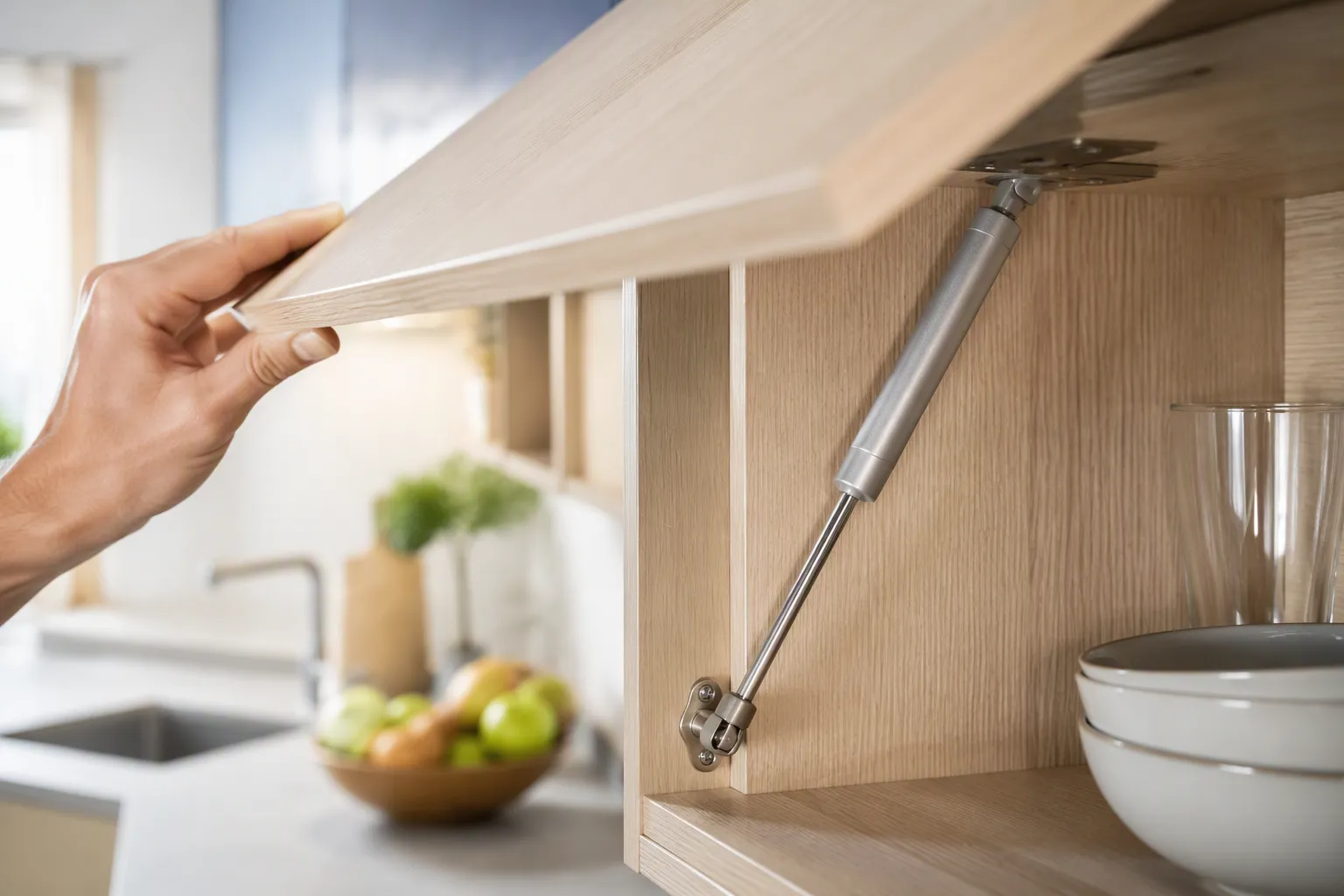
The right gas spring for your cabinet depends on four things: door weight, opening angle, mounting position, and safety. Get these wrong, and your door may not stay open or may slam shut.
Will the door hold? Will it fall? Is one spring enough? These worries are common. Learning how to choose gas springs starts with simple measurements you can take at home.
A typical cabinet strut is rated at 100N per strut, but that is a force rating, not a door weight limit. Usable support depends on mounting geometry and leverage. Quality springs from specialized manufacturers like JuTeng last 10,000 to 100,000 double strokes.
Key Takeaways
Choose gas springs based on door weight, opening angle, mounting position, and safety.
Match the spring force to your door's weight with a small safety margin to avoid slamming or dropping.
Test the spring with a temporary mount before drilling holes to ensure smooth operation.
Use two matched springs for wider or heavier doors to prevent twisting.
Soft-close springs prevent slamming and protect your furniture and fingers.
Compare Furniture Gas Spring Types
Standard vs. Soft-Close Lid Stays
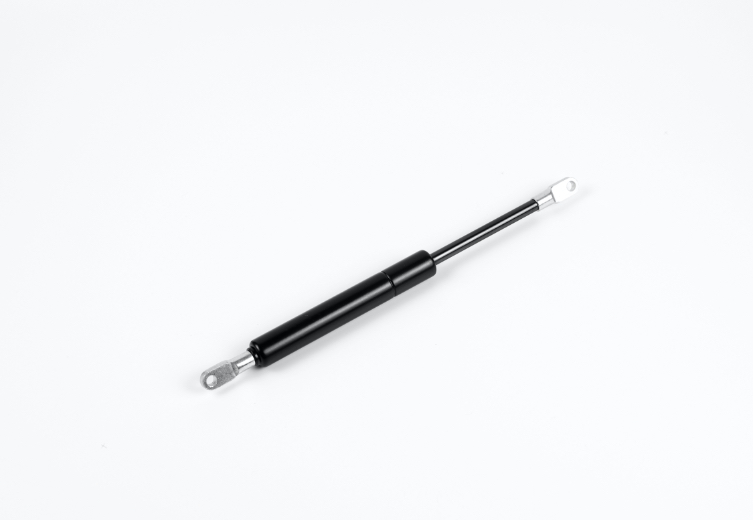
Standard lid stays are the most common choice for cabinets and lift-up doors. They use compressed nitrogen to hold the door open. The gas pushes against a piston, and the door stays up until you push it down.
Soft-close lid stays add controlled damping. They regulate closing speed, which prevents slamming. This design improves safety, durability, and user experience. Controlled closing reduces wear on hinges and cabinetry. It also protects users from injury. These stays work well for toy boxes, furniture, and high-use storage.
Many models feature soft down lid support mechanisms, which regulate closing speed to prevent sudden impact. This is particularly important in applications such as toy box lid support systems and heavy wooden chests, where safety is a primary concern.
Soft-close mechanisms reduce impact forces and minimize wear on hardware. Each system is engineered to support specific torque ranges. You must match the stay to the door weight and geometry.
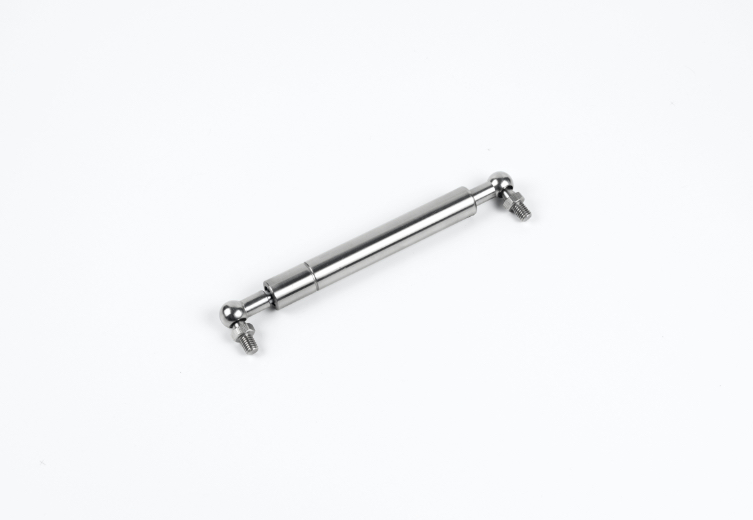
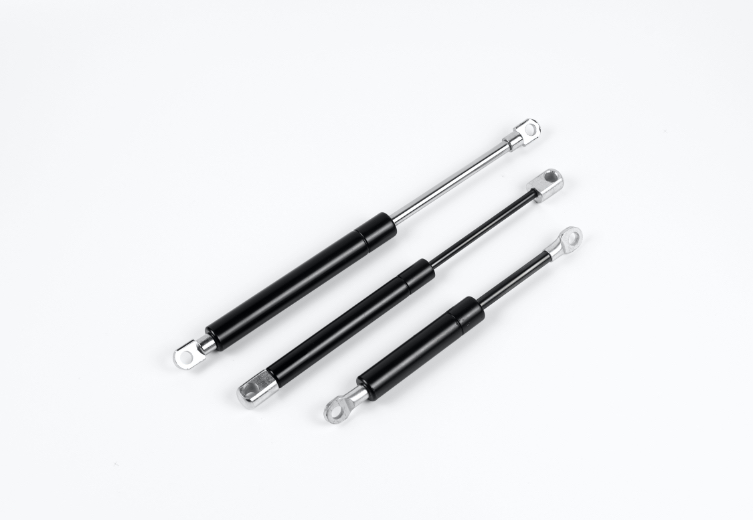
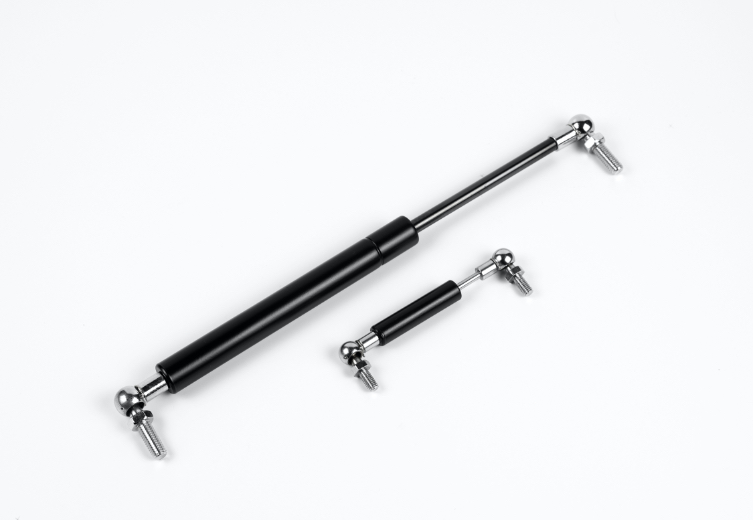
As a trusted China manufacturer, JuTeng offers a wide range of products, including compressed gas springs, lockable gas springs, dampers, and traction gas springs. For furniture, focus on compressed and soft-close types.
Adjustable-Force and Lockable Springs
Adjustable-force springs let you fine-tune opening and closing speed. They also help with precise alignment. Proper installation setup is required.
Lockable gas springs hold a door at a fixed position. An adjustable locking strut uses compressed gas in a sealed tube. Opening an internal valve lets the piston travel. Closing the valve locks the piston at that exact stroke point. The door stays fixed at any angle or height the user selects.
A fixed locking strut works differently. A preset lock engages automatically when the piston reaches a defined position. The door opens to the same stop position every time.
For furniture cabinet doors, gas springs provide firm support and controlled motion, holding the door in a variety of positions and acting as a reliable assistant to hinges so the door stays where the user places it.
How to Choose Gas Springs by Force, Stroke, and Mounting
Match Newtons, Stroke, and Spring Count
Gas spring force is measured in Newtons. Think of one Newton as a small push. If the force is too high, the door flies open. If the force is too low, the door drops. Standard furniture springs usually fall in a lower furniture-specific range.
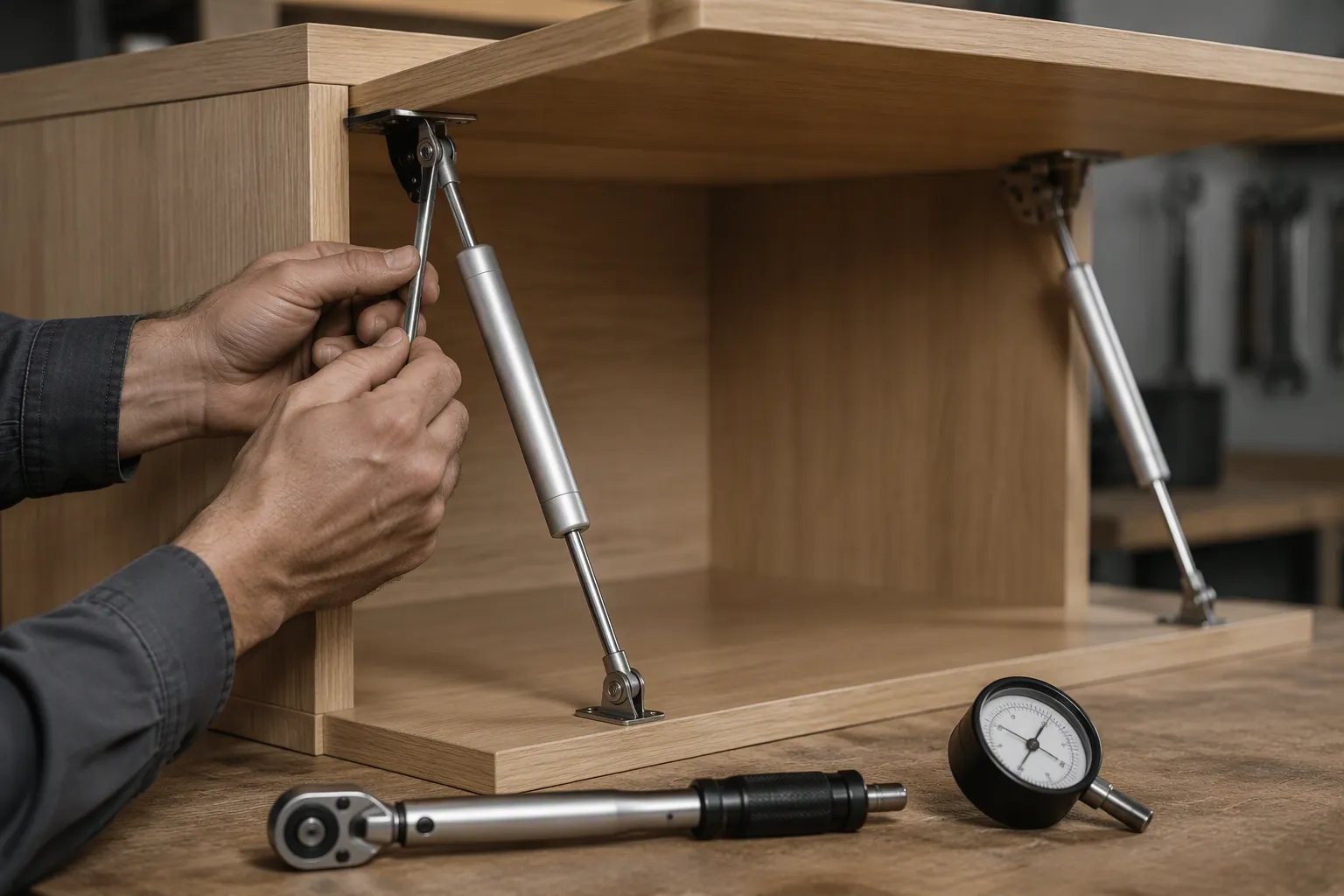
Several factors change the result. Door weight, height, hinge position, mounting geometry, opening angle, and one- versus two-strut layouts all matter. A single 100N gas strut (roughly 22 lb-force) may be sufficient for a narrow, light door, provided the tested movement stays balanced. Wider, heavier, high-use, glass, or furniture-style lift-up doors typically require two matching struts installed symmetrically for balanced support. When two struts are used, both must match and their brackets must be mirrored accurately.
Using two 100N struts does not simply double the door-weight capacity to 200N. Although two 100N force sources are present, the mounting angle and lever arm of each strut determine how much useful support actually reaches the door. Geometry still controls the usable force.
To calculate gas spring force in newtons by hand, take moments about the hinge. The force equals the lid weight in newtons multiplied by the distance to the centre of gravity, then divided by the number of gas springs and by the perpendicular distance from the hinge to the spring. Note that the perpendicular distance refers to the line of action, not the distance between brackets. One kilogram of mass exerts about 9.81 newtons of force under standard gravity.
Set Mounting Position and Opening Angle
Stroke length defines the rod travel between closed and open positions. The available stroke must match the door movement, or the opening angle will be limited. Mounting position alters leverage and bracket geometry. Moving the bracket changes the final opening angle even when the same gas spring is used. Extended length sets the open-door separation. If too short, the door cannot reach the intended angle without overextending the strut. Compressed length must allow the door to close without bottoming out. Otherwise, the usable stroke is restricted by cabinet geometry. Door and cabinet dimensions change the distance and angle between mounting points. Opening angle is therefore a result of the full layout, not just the spring size.
Factor | Relationship to stroke, mounting, and opening angle |
|---|---|
Stroke length | Defines rod travel between closed and open positions; the available stroke must match the door movement or the opening angle will be limited. |
Mounting position | Alters leverage and bracket geometry; moving the bracket changes the final opening angle even when the same gas spring is used. |
Extended length | Sets the open-door separation; if too short, the door cannot reach the intended angle without overextending the strut. |
Compressed length | Must allow the door to close without bottoming out; otherwise the usable stroke is restricted by cabinet geometry. |
Door and cabinet dimensions | Change the distance and angle between mounting points; opening angle is therefore a result of the full layout, not just the spring size. |
The same gas spring can behave differently depending on where and how it is mounted. Opening angle is not determined by the spring alone. Learning how to choose gas springs means treating the full layout as one system. When you know how to choose gas springs, you check force, stroke, and mounting together before you buy.
Follow a Simple Step-by-Step Selection Process
Weigh the Door and Calculate Leverage
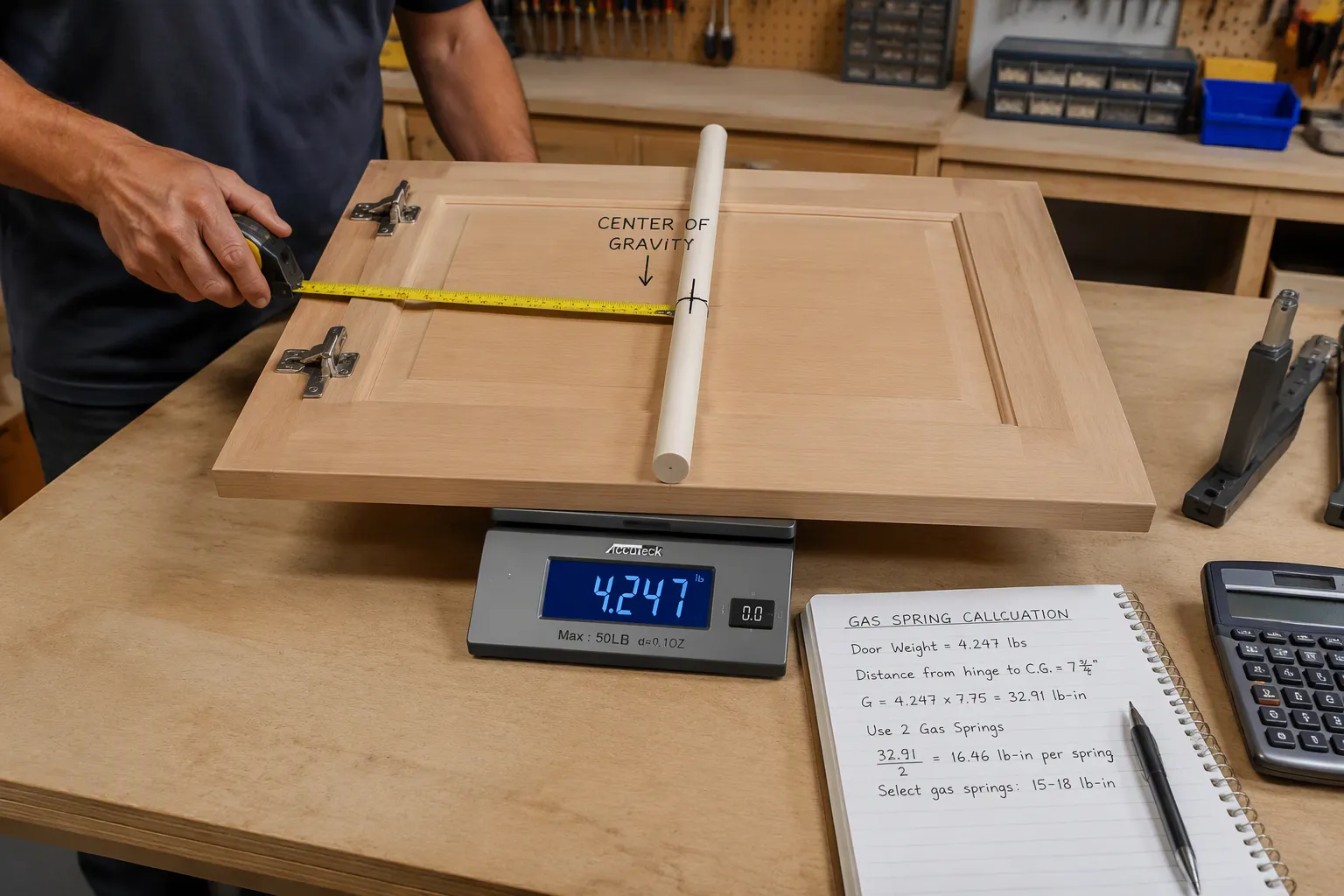
Start by weighing the finished door. Include the panel, frame, glass, handle, and any attached hardware. A sample door gives more reliable results than a material estimate. For large doors, a bathroom scale works well. For doors under 20 lb, a kitchen scale is more accurate. Remove any detachable hardware first, weigh it separately, then add that mass back.
Next, find the door's center of gravity. Balance the panel on a narrow support like a pipe or dowel. Mark the equilibrium point. On a plain rectangular door, the center of gravity sits near the middle. Glass, frames, handles, and unequal construction can shift it.
Measure the perpendicular distance from the hinge axis to that marked center of gravity. This distance, multiplied by door weight, gives the torque the spring must overcome. A greater door height moves the center of gravity farther from the hinge, which increases the required spring force.
Now apply the moment-balance formula. The simplified equation is Fspring = (m × g × Lcg) ÷ (n × r⊥). Here, m is the total moving mass in kilograms, g is gravitational acceleration at 9.81 m/s², Lcg is the perpendicular distance from the hinge to the load's center-of-gravity line in meters, n is the number of springs, and r⊥ is the perpendicular distance from the hinge to one spring's line of action in meters.
For example, an 18 kg lid with a 0.40 m load arm creates about 70.6 N·m of moment. With two springs and a 0.09 m effective spring arm, the result is about 392 N per spring at that position.
A common selection approach uses F1 = G x L / b x n x K. Here, G is the load, L is the distance from hinge to center of gravity, b is the effective gas spring lever arm, n is the number of gas springs, and K is a safety or friction factor. Treat this as an engineering starting point. Confirm it with actual mounting geometry.
Don't want to do the complex math by hand? JuTeng provides free calculation and motion simulation services for furniture manufacturers and custom projects. Simply send us your door dimensions and weight, and our engineers will recommend the exact gas spring model.
Test, Adjust, and Confirm Before You Install
Check the manufacturer's charts and catalog first. JuTeng offers professional engineering services such as 3D modeling, component calculation, motion simulation, and prototype creation. These tools verify fit and natural compression before you commit to a layout.
For at-home makers, test with a temporary mount before drilling final holes. Follow these steps:
Mark the proposed bracket locations using your calculated dimensions, panel weight, hinge position, and desired opening angle.
Hold the gas spring at those locations with temporary supports or clamps. Do not drill permanent holes yet.
Open and close the panel to verify that the spring force provides the correct lift and closing pressure.
Check that the mounting angle keeps the end fittings aligned and that the strut has full clearance in both open and closed positions.
Adjust the temporary supports until force, leverage, travel, and opening angle are confirmed.
Transfer the final bracket positions for permanent drilling.
Once the first complete door performs correctly, pre-drill pilot holes, secure the brackets, and use a drilling template to repeat the layout. This process removes guesswork from how to choose gas springs and ensures consistent results across multiple doors.
Avoid Common Gas Spring Mistakes
Avoid Wrong Force and Spring Count
Too much force creates real danger. An overpowered spring can make the door slam shut. It may also stop the door from closing at all. Over time, that extra stress damages hinges and loosens screws. The fix is simple: match the spring rating to the actual door weight with only a 10–20% safety margin. Do not oversize the spring "just to be safe."
Too little force causes different problems. The door will not stay up. It may fall near the top of its swing. A single strut on a wide door also causes twisting. Two-strut setups need matched springs and mirrored brackets. Otherwise, the door moves unevenly.
Common Mistake | Likely Reason | Correction |
|---|---|---|
Strut bottoms out or force is excessive | Recheck compressed length and mounting geometry | |
Door falls near the top | Insufficient support or poor leverage | Review force, mounting points, and spring count |
Door twists while opening | One-sided support on a wide door | Use matched struts and correct hinge alignment |
Assuming one 100N strut holds a 22 lb door | Confusing force rating with door capacity | Understand that leverage and geometry change usable support |
Avoid Wrong Stroke, Mounting, and Hardware
Stroke length must match the door's full range of motion. Measure the space carefully before buying. A spring that is too short limits the opening angle. A spring that is too long cannot compress enough for the door to close.
Mounting angle matters for safety. An incorrectly angled spring can let the door drop unexpectedly. Also confirm that end fittings match your brackets.
High-quality springs from specialized manufacturers like JuTeng are rigorously tested to last 10,000 to 100,000 double strokes.
Do not skip checks on environmental ratings, locking mechanisms, or hardware compatibility. When unsure about force and stroke calculations, use free expert design services rather than guessing.
Choosing correctly is not a guess. How to choose gas springs rests on four factors: force, stroke, mounting position, and safety. Door weight alone does not size the spring. Leverage and angle matter just as much.
Use JuTeng's force charts and mounting diagrams. These tools simplify how to choose gas springs. Our engineering team can verify fit before purchase. Then perform a physical test. Mount the spring temporarily. Open and close the door. Confirm smooth, controlled action. Verify force matches door weight. Check the stroke against your measured travel.
Once you weigh the door, measure the hinge position, and set the mounting angle, you pick a spring that opens smoothly and stays where you want it.
FAQ
How do I know if one gas spring is enough for my cabinet door?
One spring often works for narrow, light doors. Wider or heavier doors need two matched struts with mirrored brackets. A single strut on a wide door causes twisting. Test with a temporary mount before drilling final holes.
What happens if the gas spring force is too high or too low?
Too much force makes the door fly open or slam shut. Too little force lets the door drop near the top of its swing. Match the spring rating to the actual door weight with only a 10–20% safety margin.
Can I install a gas spring at any angle?
No. Always follow the manufacturer's mounting diagram.
How long do quality furniture gas springs last?
High-quality springs from specialized manufacturers like JuTeng are rigorously tested to last 10,000 to 100,000 double strokes. Cheap springs may fail sooner and risk door damage or injury.
Do I need soft-close gas springs for my lift-up door?
Soft-close stays add controlled damping. They regulate closing speed, which prevents slamming. This design improves safety and reduces wear on hinges. Soft-close works well for toy boxes, furniture, and high-use storage.
Need Help Calculating Your Gas Spring Requirements?
Don't want to do the complex math by hand? JuTeng provides free calculation, 3D modeling, and motion simulation services for furniture manufacturers and custom projects. Simply send us your door dimensions and weight, and our engineers will recommend the exact gas spring model.
Contact JuTeng's Engineering Team for a Free Quote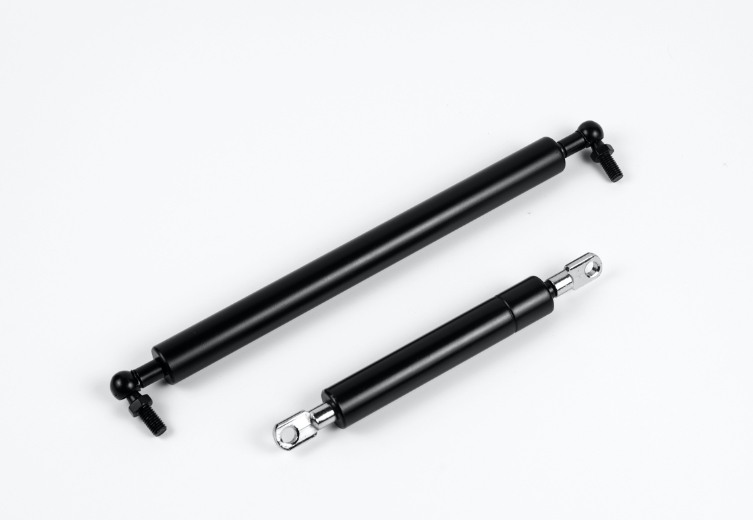
Recent News
1.How Gas Struts Differ from Gas Springs and Shock Absorbers
2026-09-142.Lockable Gas Spring Applications for Bus Seats
2026-08-293.Adjustable vs Ordinary Gas Springs Selection Guide
2026-09-214.Comparing Gas Spring Suppliers in China Key Factors to Consider
2026-10-095.The Ultimate Guide to Picking the Right Gas Spring for Your Auto
2026-08-31