




How to Select the Right Gas Strut for Storage Boxes
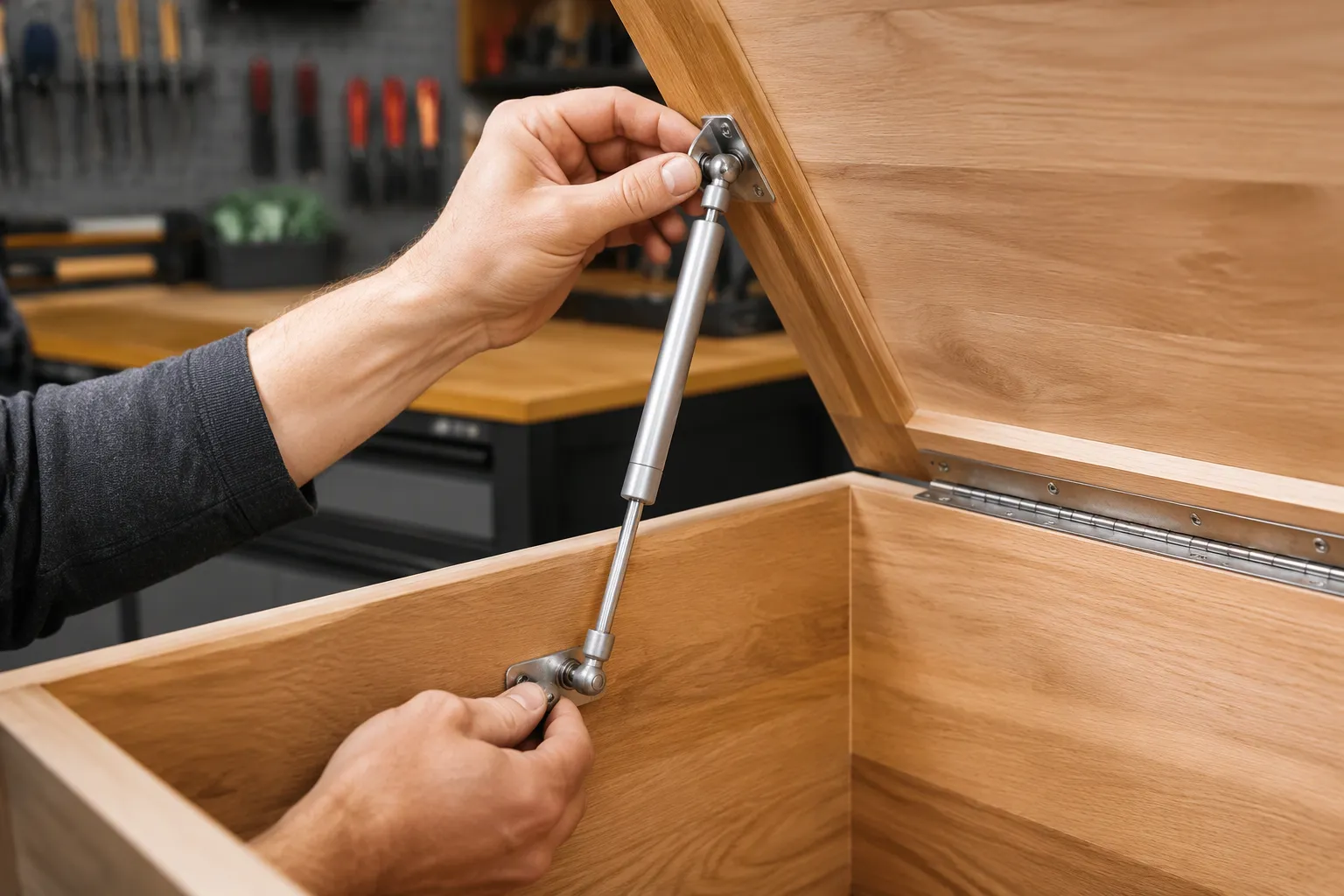
A heavy toolbox lid slams down without warning. A storage chest lid fights back every time someone tries to hold it open. Both failures share one cause: the gas strut was never matched to the lid it supports.
Most guides answer that problem with a rule of thumb and a catalog page. That approach leaves the buyer with a number nobody can check. A gas strut force calculation needs only two measurements and the weight of the lid, and the result can be compared against a published rating before anything is ordered.
The work below runs in four steps: measure the lid and the box, calculate the force, plan the mounting, then match material and seal to the environment. Each step produces numbers the next step needs, and step two is the one that decides whether the lid holds. The method applies to any gas strut for storage box lids, from a garden bench to a truck bed chest.
Key Takeaways
Required gas strut force follows the moment balance F = (W × D) / L, where W is lid weight in newtons, D is the hinge-to-center-of-gravity distance and L is the hinge-to-mounting-point distance. A 12 kg lid at D = 0.25 m and L = 0.42 m needs about 70 N of lift before angle correction.
Rated force is not delivered force. A gas strut meeting the lid at 30° converts only half its rating into lift, so the axial rating has to be divided by the sine of that angle.
F1 is measured at 20 °C with the rod extended 5 mm. Temperature moves the figure, and a unit tuned on a warm day feels weak at -10 °C.
Mount the rod down, within 60° of vertical. That orientation keeps oil at the rod seal, and it decides service life more than body material does.
For replacement work, read the markings on the old gas strut first. It gives length, force and end fitting in one line, which is faster than measuring a lid still bolted to a truck.
Add 10% to 15% over the calculated force for hinge friction and pressure drift. A margin above 50% strains hinges and makes the lid hard to close.
How to Choose a Gas Strut for a Storage Box
The Four Decisions, in Order
Most questions about how to choose a gas strut resolve into four factors: measurement, force ratings by lid weight, mounting, and environment. They are not independent. A correct length means nothing if the force is wrong, and a correct force fails if the brackets sit at a poor angle.
Measurement comes first because stroke and lid length feed every later number. Force comes second because lid weight sets the rating. Mounting comes third because bracket position changes how much of that rating reaches the lid. Environment comes last because material and seal choice follow from where the box sits, not from the load it carries.
What to Gather Before Starting
Gas struts for toolboxes and storage chests provide smooth, controlled opening and closing. Heavy-duty gas struts are available across a range of sizes and strength ratings for truck toolboxes, cabinets, and storage chests. Preparation shortens the selection considerably.
Four items cover it: a tape measure for lid depth, box depth and mounting distances; a scale for lid weight; the open and closed geometry of the box, meaning the lid angle at rest and at full lift; and the markings on any gas strut already fitted.
Write the weight and both angles down. Those two figures drive the force calculation and the mounting check, and a recorded number survives the trip to a supplier in a way that a remembered one does not.
Step 1: Measure the Lid and the Box
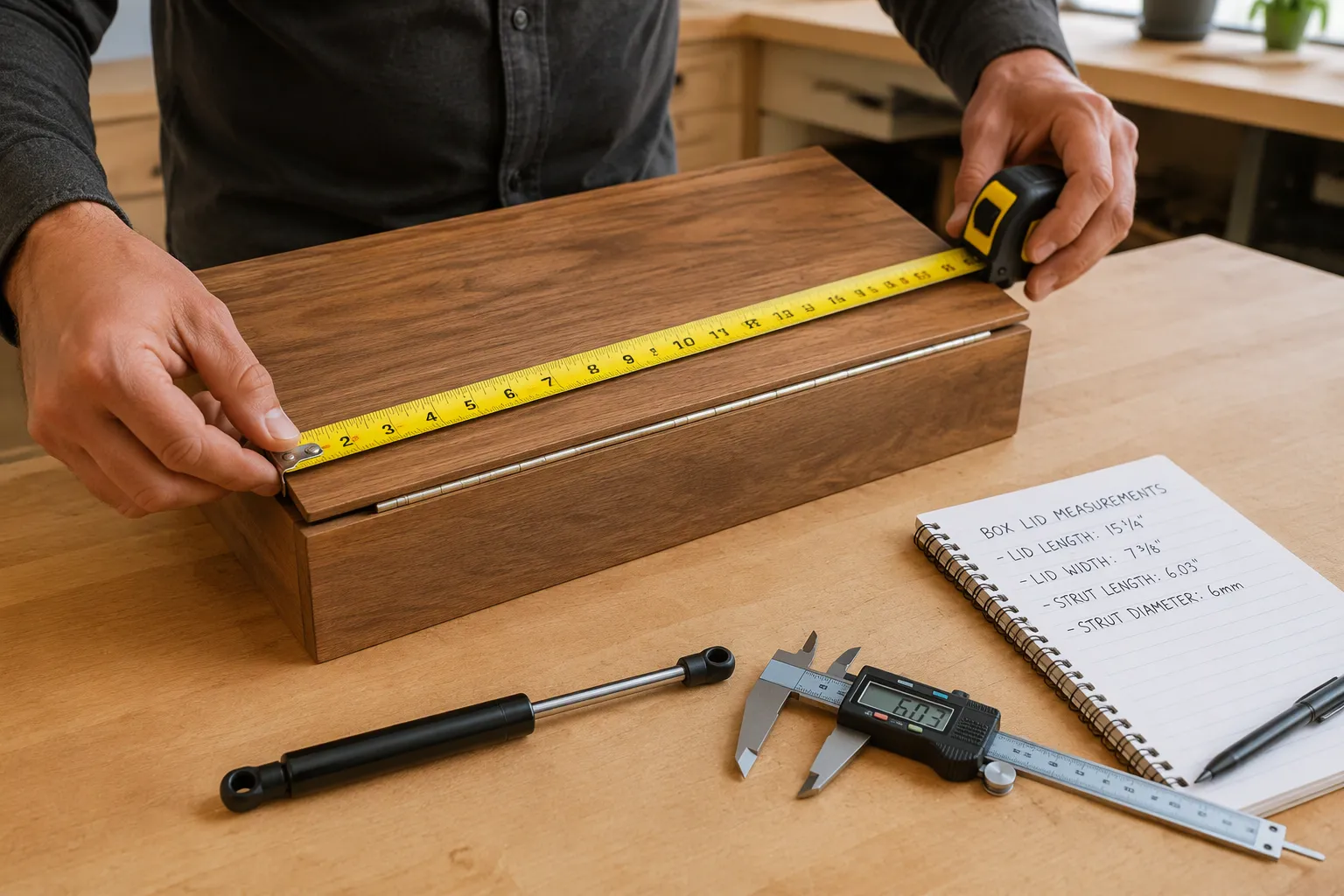
Measurement turns a vague problem into a set of numbers. Every gas strut selection starts here, because it settles length, stroke and diameter before any force calculation begins. Skipping it produces a gas strut that binds, bottoms out, or mounts where no bracket fits.
Extended Length, Compressed Length, and Stroke
Three length figures matter, and they are not interchangeable. Most ordering errors trace back to confusing two of them.
Term | What it describes |
|---|---|
Extended length | Center-to-center distance between mounting points when the rod is fully out |
Compressed length | Center-to-center distance when the rod is fully in, which sets the space the strut needs when the lid closes |
Stroke | Travel between the two, equal to extended length minus compressed length |
Extended length sets reach at full lid opening. Compressed length decides whether the unit fits when the lid shuts, and it is the figure buyers forget. A gas strut with the right extended length and too little stroke stops the lid short or bottoms out before the lid closes, and internal bottoming damages the seal.
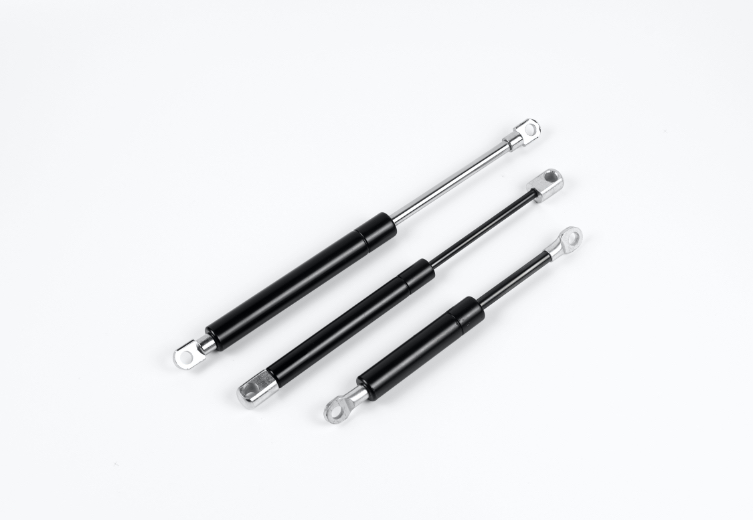
Published ranges make this concrete. One lift series covers 206 mm to 700 mm extended length with 60 mm to 290 mm of stroke, paired as model rows such as 300/100 and 550/220. The first number is extended length in millimeters, the second is stroke. A buyer who supplies lid geometry rather than a wish for "about 18 inches" gets a row off that table instead of a guess.
The 60% Rule as a First Filter
A common rule of thumb sets gas strut lengths and stroke options at roughly 60% of the lid depth, measured from the hinge to the free edge. A lid 500 mm deep points toward a unit near 300 mm extended, which exists in the series above.
Treat that figure as a shortlist filter, not an answer. The 60% rule and the moment calculation in step two come from different places: the rule from accumulated fitting experience, the calculation from torque about the hinge. They usually land close, and they diverge when the lid is shallow, when the mounting point is forced inward by a brace, or when the box has a lip that limits bracket height. When they disagree, the calculation wins and a trial fit confirms it.
Rod and Tube Diameter
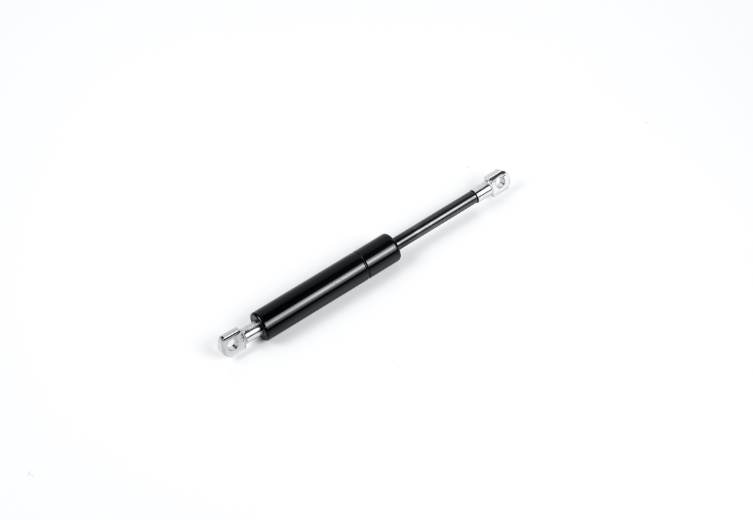
A gas strut is also identified by rod and tube diameter, and both appear in catalogs and on the body itself. The tube is the outer pressure cylinder. The rod is the piston rod sliding in and out of it. A 18/8 marking means an 18 mm tube and an 8 mm rod.
Diameter carries load meaning. A larger tube holds more gas volume and generally supports a higher force rating. A thicker rod resists bending under side load, which matters on wide lids that twist. Measure both with calipers or read them off the existing unit, then confirm the diameters suit the brackets already on the box.
Choosing a gas strut for storage box lids differs from choosing one for a car tailgate, because a box lid swings on a horizontal hinge over a short stroke. Record four figures before moving on: lid depth, extended length, stroke, and rod and tube diameter. These form the measurement half of the gas strut checklist, and step two builds on them directly.
Step 2: Calculate the Force
Gas strut force decides how the lid behaves in the hand. Too low and the lid drops. Too high and it springs open and resists closing. The rating comes from two numbers, lid weight and mounting geometry, and both are measurable before purchase. A coil spring gets stiffer the further it compresses, which is why its rating is a curve; a gas spring holds near-constant force across the stroke, so the number on the label stays close to what the lid feels.
The Moment Balance Formula
A lid is a lever, and it turns on a turning moment about a hinge. The lid creates a closing torque, and the gas strut supplies an equal opening torque. That balance gives the minimum force perpendicular to the lid:
F = (W × D) / L, where W is lid weight in newtons (mass in kg × 9.81), D is the horizontal distance from hinge to center of gravity, and L is the distance from hinge to the strut mounting point on the lid. The complete form for force calculation and mounting rules divides by the sine of the strut angle and multiplies by the cosine of the lid angle, which is what makes the same lid feel different at two mounting points.
A worked example makes it usable. A truck toolbox lid of 12 kg, with its center of gravity 0.25 m from the hinge and a mounting point 0.42 m from the hinge, gives W = 117.7 N and F = (117.7 × 0.25) / 0.42 = 70 N perpendicular to the lid. At a 40° strut angle the axial rating must be 70 / sin 40° = 109 N. Add 15% for friction and drift, and the target is 125 N.
That is the number to quote to a supplier, not a length in inches. Two gas struts share it, so the pair asks for roughly 63 N each, and the smallest standard step in a lift series is often 80 N. The arithmetic also explains a common surprise: doubling the strut count does not double the lift, it halves the per-unit rating.
Weigh the Lid and Find the Load Point
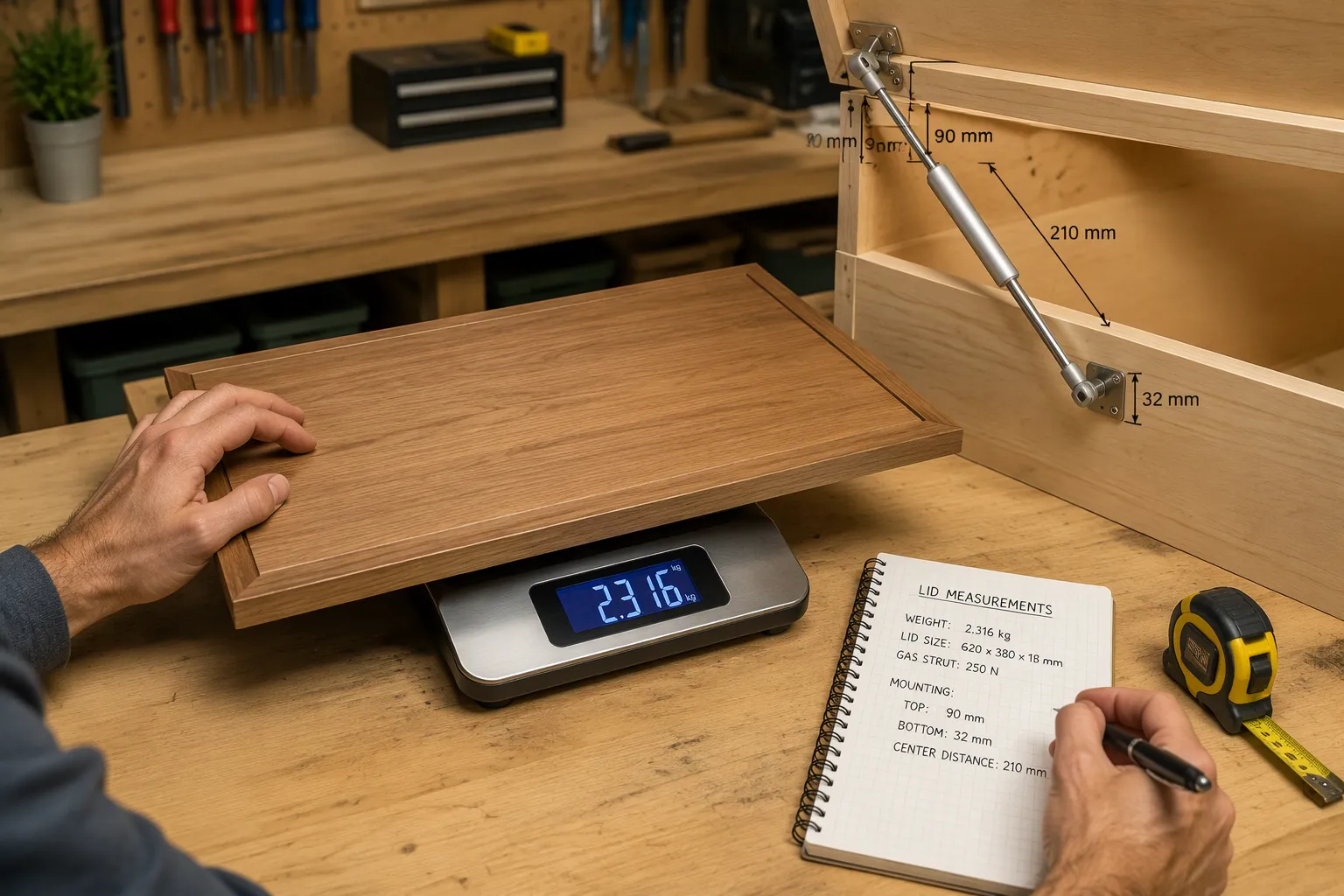
Weigh the lid where it sits. Removing a welded truck lid is not realistic, and it is unnecessary. Support the lid at its center of gravity in the closed position with a scale under the free edge, read the static load, and double it if the scale sits midway between hinge and edge. A detachable cabinet door can go on a bathroom scale directly. Keep one unit system for the whole gas strut selection.
The load point matters as much as the weight. A strut mounted near the hinge carries a small share of the lid load. One mounted near the free edge carries much more. Required force falls as L grows, which is why a longer bracket arm can lighten a heavy lid without changing the spring. Record the hinge-to-mount distance on the lid and the matching distance on the box wall. Those two figures define the lever.
How the Mounting Angle Cuts Effective Force
Only the component of strut force perpendicular to the lid lifts anything. A strut meeting the lid at a shallow angle wastes most of its rating pushing along the lid instead of raising it. The table below holds the required perpendicular force constant at 70 N and shows what the axial rating has to be at each angle.
Angle between gas strut and lid | Share of rated force reaching the lid | Axial rating needed for 70 N of lift |
|---|---|---|
90° | 100% | 70 N |
60° | 87% | 81 N |
45° | 71% | 99 N |
30° | 50% | 140 N |
20° | 34% | 205 N |
The angle also changes through the stroke. A gas strut mounted so it meets the lid near perpendicular at the closed position will be far from perpendicular when the lid stands upright. That is why the load has to be checked at both ends of travel, and why two boxes with identical lids can need different springs.
F1, Force Tolerance, and Safety Margin
A gas strut can be too strong for a light lid. An oversized spring holds the lid open against the frame, strains the hinges, and turns closing into a two-handed fight.
Match the rating to the measured lid weight, not to the size of the box. Check that the chosen force range suits the lid and will not damage the hinges, and confirm which quantity the supplier is quoting.
F1 is the rated force at a defined condition: 20 °C, rod extended 5 mm, measured on a force frame. It is not the internal charging pressure, and the two are routinely confused. A supplier quoting pressure while a buyer expects F1 is the source of rejected batches, because the same internal pressure yields different F1 values once oil volume, rod diameter and temperature differ. Ask which one appears on the drawing.
Tolerance matters next. A ±5% band holds its rating over life and keeps paired units matched. A commodity part at ±10% to ±15% drifts between batches, and a mismatched pair on a wide lid shows up as a lid that lifts crooked. Specify the band, then add a 10% to 15% margin above the calculated force for hinge friction and gas permeation. Gas loss runs about 3% to 5% a year, so a unit sized to the bare minimum is undersized within two or three years.
A margin above 50% stops being helpful. It holds the lid against the frame, overloads the hinges and makes closing hard, which is the failure in the quotation above.
Replacing an Existing Gas Strut
Replacement has a shortcut worth taking. The original unit carries markings for length and force, and sometimes an OEM part number. That pairing is the baseline, and it is more reliable than measuring a lid still bolted to a truck. Read the rod and the label, note the end fittings, then check the length against the 60% filter from step one. Where the two disagree by a wide margin, measure the lid again before ordering.
Adjust from that baseline only when something changed: a heavier lid, a new hinge position, or a different mounting spot. A like-for-like swap that follows the old markings is the safest replacement, and it is also the fastest. What a force rating in newtons means in practice, and how to read a 250 N or 100 N marking, is worth confirming before the order goes out.
Step 3: Plan the Mounting
Sizing and positioning a gas strut is one combined decision, not two. The right force, the correct length and the mounting position interact for a specific application, and a unit that works on a workbench can feel wrong once bolted to the box. This step converts recorded measurements into a layout.
Bracket Angle and Clearance
Bracket angle shapes the lift feel of a gas strut more than most buyers expect. A gas strut close to perpendicular to the lid delivers predictable support through the stroke. A shallow angle wastes rating and leaves the lid heavy near the closed position. Aim for an angle that stays efficient across the full swing, and accept a compromise at one end when the box geometry forces it.
Clearance gets equal attention. The tube and rod must clear the lid edge, the box wall and any contents at every point of travel. The unit must not bind against the frame at full compression, and the lid must not rely on the strut as a mechanical stop at full extension, because internal bottoming damages the seal. Confirm the mounting position against the open and closed geometry recorded earlier. A small change in bracket height often fixes a lid that lifts unevenly.
Mount the Rod Down
Orientation is the least visible decision and one of the most consequential. Standard gas struts are mounted rod down, within 60° of vertical. In that position oil sits at the rod seal, lubricating it on every stroke. Mounted rod up, or near horizontal, the seal runs dry, and service life falls well before the force rating is used up.
A storage box lid is the awkward case, because a horizontal lid pulls the gas strut toward horizontal with it. Two options fix that. Mount the brackets low on the box wall and far along the lid so the working position stays steep enough, or specify a unit with an oil chamber or full damping, which keeps the seal lubricated in non-standard orientations. Ask for the orientation before assuming a standard gas strut will last.
One Gas Strut or Two
A single gas strut suits narrow lids and light loads. It keeps cost and installation simple and fits boxes with limited mounting space. It also leaves one side of the lid unsupported, so a wide lid may twist under load.
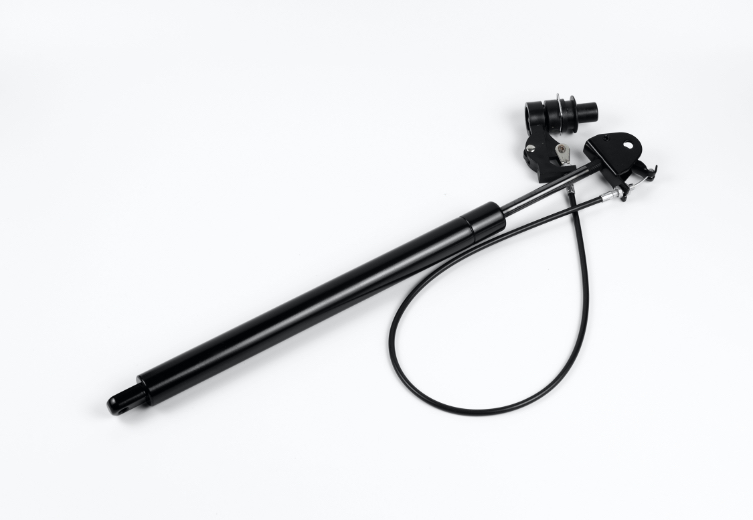
Two gas struts fit wide lids, heavy chests and truck toolboxes where balanced lift matters. They share the load and keep the lid square through the stroke. Each carries roughly half the total requirement, so the per-unit rating halves, as the worked example showed. Match the count to lid width and weight, then confirm the brackets mirror each other. Where the mechanism has to hold a lid closed rather than push it open, the sizing method for pulling struts differs, because a pulling strut acts in the opposite direction to the compression units used on box lids.
End Fittings Complete the Part Number
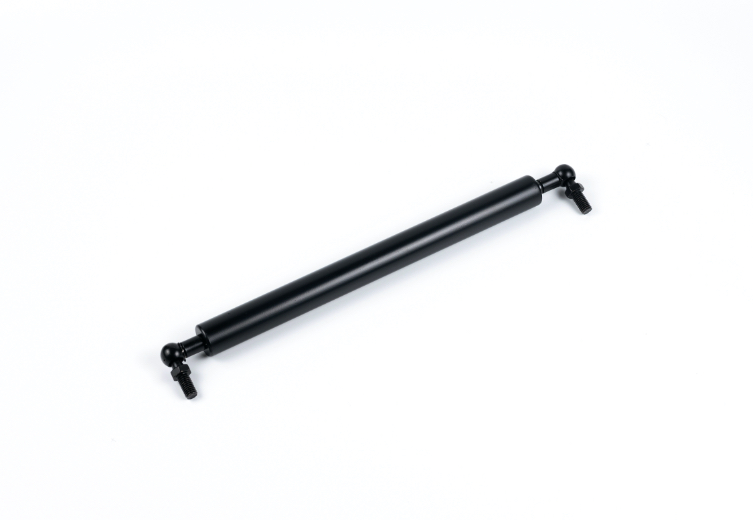
The end fitting is the last gas strut spec most buyers leave blank, and it changes installed geometry more than expected. Ball sockets allow off-axis movement and tolerate slight misalignment. Eyelets and pin fittings suit a clevis bracket and give a defined pivot axis. Threaded ends accept a rod end for precise adjustment. Fixed brackets lock the angle and remove the freedom to tune it later.
Choose the fitting that matches the bracket already welded to the box. Replacing a fitting because it is easier to source can shift the mounting points by several millimeters, which changes the angle, and the calculation in step two was built on the old one. Note the fitting type alongside length and force, because the part number needs all four.
Step 4: Match Materials to the Environment
Location decides the last set of choices. An indoor chest sees stable air and little moisture. A truck toolbox, a marine locker or an outdoor storage bench faces rain, salt and temperature swings. Material and seal selection follow that exposure, not the load.
Corrosion Protection
Gas strut body material is the first defense against rust. Steel offers strength at low cost and suits dry indoor storage. Stainless steel resists corrosion in damp, salty and coastal settings. Coating a steel body, with a plated rod to match, handles occasional moisture at a lower price than stainless and is the usual choice where cost and protection both matter.
Body and rod finish | Where it fits | What to confirm |
|---|---|---|
Painted or coated steel body, plated rod | Indoor chests, cabinets, sheltered garages, and mixed use where cost and protection both matter | Coating thickness, rod plating, agreed salt-spray hours |
Stainless steel body and rod | Outdoor, marine and washdown environments | Grade, salt-spray hours, seal compound |
Confirm the salt-spray hours against a named method such as standard salt spray test practice, otherwise two suppliers quoting 480 hours may mean different exposures. The rod deserves separate attention. It slides through the seal on every stroke and carries whatever the box is exposed to straight into it. A plated rod under a coated body is a reasonable pairing, but a bare rod on an outdoor box scores, and a scored rod destroys the seal that follows it.
Seals, Temperature, and Service Life
Gas strut seal quality governs service life as much as body material. A sound seal keeps the nitrogen charge in and moisture out. A worn one lets pressure escape and ends the working life early. NBR is the standard compound and covers ordinary indoor and outdoor use. HNBR resists UV and ozone better, which matters on marine units and anything stored in direct sun.
Temperature range drives the choice further. Units are commonly specified from -40 °C to +80 °C, and gas pressure tracks temperature inside that window: a gas strut balanced on a warm afternoon will feel weak on a cold morning, and the same unit at the top of its range will push harder than the calculation predicted. Where the box spends time outside that band, the seal moves to FKM, and PTFE and modified PTFE components cover roughly -46 °C to 180 °C.
Life figures give the sizing a horizon. A well-made gas strut is commonly quoted at 10,000 to 50,000 double strokes, and the real number depends on installation and cycle rate. Combined with the 3% to 5% annual force loss, that sets the replacement interval far better than a calendar guess.
Duty Cycle
Duty cycle counts as a selection input. A lid opened twice a day asks little of a gas strut. One cycled constantly in a commercial setting asks for seal quality, damping and a force tolerance the first case never notices. Match the unit to the typical gas strut applications and load levels its cycle rate implies rather than to the box it sits on.
Damping
The opening complaint in this article was a lid that slams. Force alone does not fix that, because a spring strong enough to hold a lid open is also strong enough to snap it shut once the load passes over center. A damper, or a gas strut with built-in hydraulic damping, controls the last part of the travel and removes the slam without changing the holding force.
Send the lid weight, hinge position and mounting distances. Engineering will return a force and stroke recommendation against a real series.
Get a QuoteThe Selection Checklist
From Measurements to Part Number
The earlier steps produce a set of figures. A gas strut checklist keeps them in one place and turns them into an order. Work through the items in sequence:
Lid depth and lid weight, measured rather than estimated
Extended length, compressed length and stroke, cross-checked against the 60% filter
Rod and tube diameter, matching the existing brackets
Hinge-to-center-of-gravity and hinge-to-mount distances, with the strut angle at both ends of travel
Calculated force, plus 10% to 15%, plus the tolerance band and the F1 measurement condition
Mounting orientation, bracket angle, clearance at full compression, and strut count
Environment, body and rod finish, seal compound, temperature range, duty cycle and damping
End fittings at both ends
Each line feeds the next. Lid depth narrows the length shortlist. Weight and load point set the force. Environment decides the finish. A buyer working through the sourcing checklist for ordering gas struts will find this order removes guesswork, because every value has a measurement behind it.
The finished checklist becomes a part number. Most suppliers build that number from length, force rating, end fitting and body material, and some add seal compound and damping. Read the list down the page and assign each value in turn. A 300 mm extended length, 100 mm stroke, 150 N F1 at ±5%, two ball sockets and a coated body is one complete specification. Confirm the supplier numbering format before ordering.
Test Fit and Adjust
Install the gas strut with the lid supported, then test the full swing by hand. The lid should lift with light effort, hold at the open position and close under control. Listen for binding and watch for contact between tube and frame.
Adjustment of a new gas strut after a test fit is normal. Move a bracket slightly to change the angle, or step to a neighboring force rating when the lid feels heavy or too eager. Recheck clearance at full compression, confirm the rod still sits down, and record the final settings for the next replacement. A photographed bracket position is faster to match than a remembered one.
Putting the Four Steps Together
The sequence is short. Measure the lid and box, calculate the force from lid weight and geometry, plan the mounting and strut count, then check durability for the environment. Finish with the checklist and confirm every value before ordering.
Two habits carry most of the benefit. Record measurements instead of estimating them, since every later number depends on lid weight and hinge distances. Expect to fine-tune the force rating or bracket position after a test fit, because a calculation narrows the choice and a trial confirms it.
JUTENG manufactures compressed gas springs, lockable gas springs with built-in hydraulic damping, dampers and traction gas springs, filled with nitrogen and flame-retardant oil, produced under ISO 9001 and supported by OEM, ODM and engineering review of lid geometry before tooling. A specification built on the four steps above can be quoted against a standard series or a custom gas strut, and the difference between the two is a drawing rather than a guess.
The practical next step is to send the completed checklist to a supplier and ask for a recommendation on length, force, fitting and material. That conversation about what a force rating means in newtons turns a lid that fights back into one that holds.
Comparing a standard series against a custom unit? Send the lid drawing and the cycle rate.
Contact Us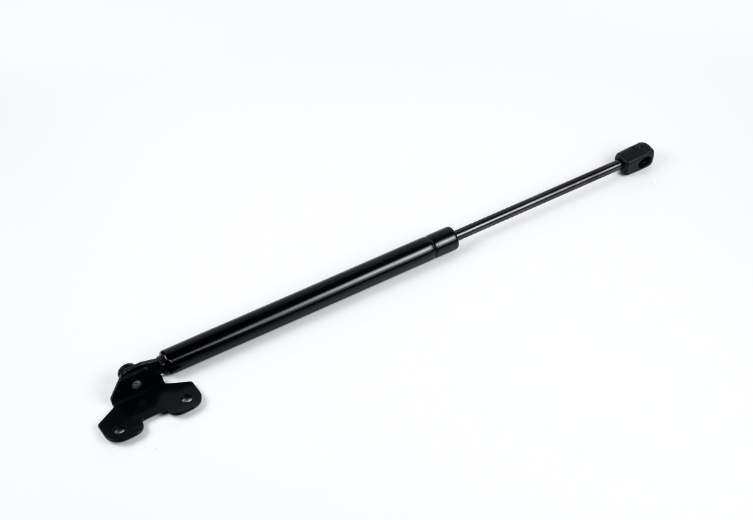
Lift Gas Strut 18/8
80 N to 800 N F1, 60 mm to 290 mm stroke, 206 mm to 700 mm extended.
View Product
Compressed Gas Springs
Full series for lids, hatches, cabinets and toolboxes.
View Range
Dampers
Controls closing speed where a lid must not slam.
View RangeFAQ
Is the 60% rule a firm requirement?
No. It is a shortlist filter for extended length, taken from fitting experience rather than from torque. A 500 mm deep lid points toward roughly 300 mm extended. The moment calculation and a trial fit confirm the final figure, and they take precedence when the two disagree.
Can a stronger gas strut damage the box?
Yes. An oversized unit strains hinges, holds the lid against the frame and makes closing hard. Match the force to the measured lid weight and add 10% to 15%, not more. A margin above 50% is over-specified for a storage box lid.
How do I replace an original gas strut?
Read the markings on the old unit first. They give length, force and often an OEM number, which is a more reliable baseline than measuring a lid still attached to a truck. Confirm the length against the 60% filter, note the end fittings, and adjust only if the lid, hinge or mounting position changed.
Do I need one gas strut or two?
Narrow, light lids with limited mounting space suit a single unit. Wide or heavy lids, including truck toolboxes, suit two, because balanced lift keeps the lid square. Each unit in a pair carries about half the total requirement, so the per-unit rating halves.
Which material suits an outdoor storage box?
Stainless steel fits outdoor, marine and washdown settings. Coated steel with a plated rod handles occasional moisture at lower cost. Confirm salt-spray hours and seal compound rather than accepting a material name, and check the rod surface, because it carries exposure into the seal.
How much does temperature change the force?
Enough to notice in the hand. Internal pressure tracks temperature, so a gas strut balanced at 25 °C feels weaker near -10 °C. Units are commonly rated from -40 °C to +80 °C. Where the box sits outside that band, change the seal compound to FKM or specify an oil chamber.
How long does a storage box gas strut last?
A well-made unit is commonly quoted at 10,000 to 50,000 double strokes, and force decays about 3% to 5% a year through gas permeation. Installation orientation and cycle rate decide where a specific box falls in that range, so a unit sized to the bare minimum calculation is undersized within a few years.