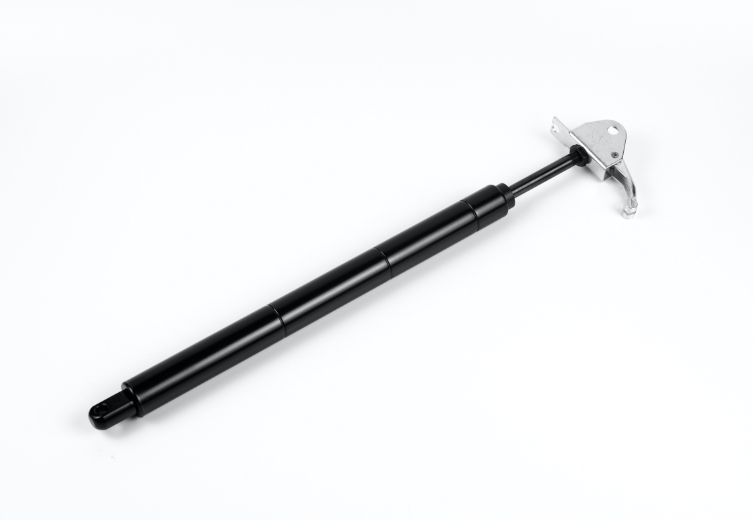





Adjustable vs Ordinary Gas Springs Selection Guide
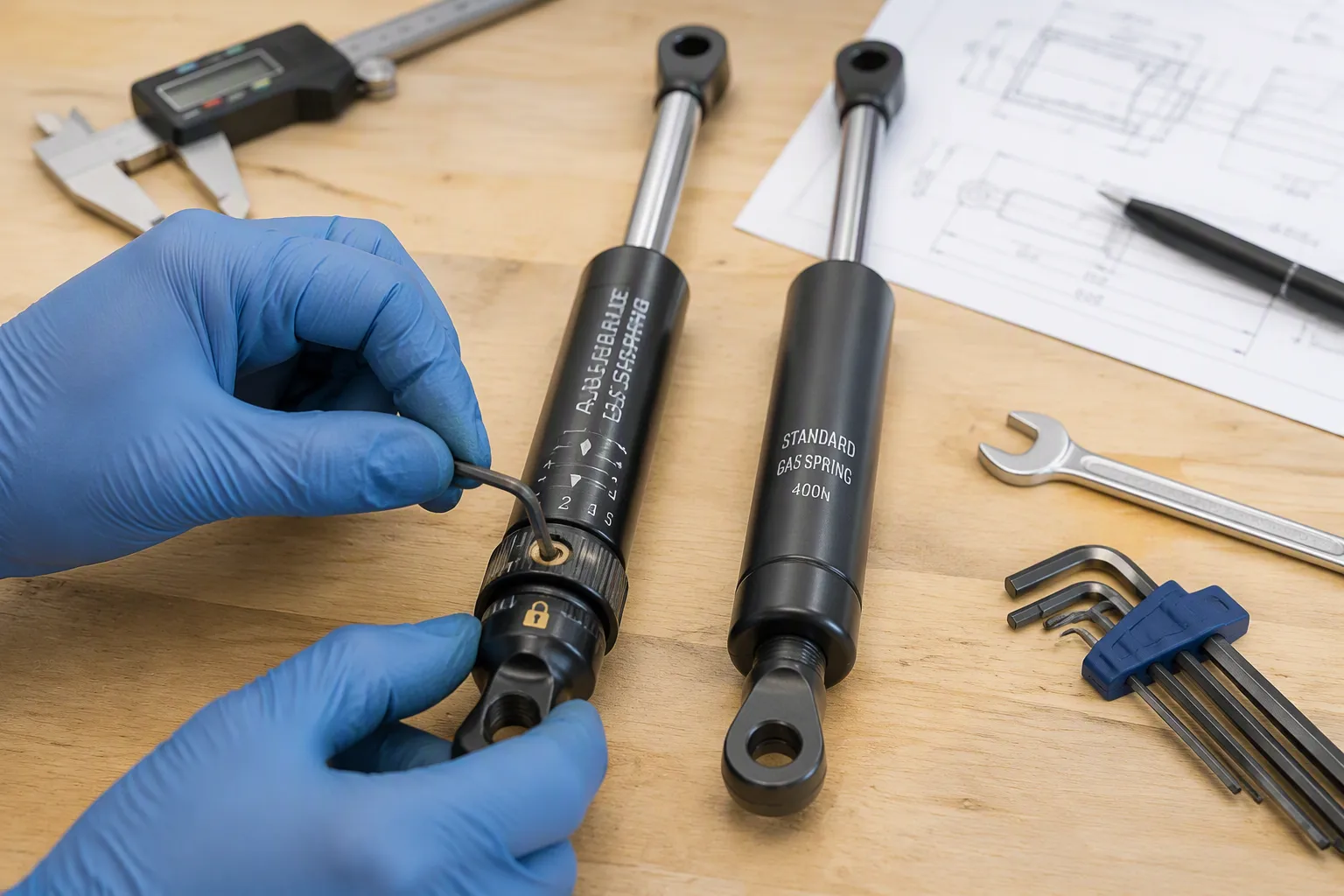
Selecting the right gas spring for a new design often presents a difficult choice. Adjustable gas springs deliver variable force, precise positioning, and one part number across multiple configurations. Ordinary gas springs serve fixed-force, high-volume, and cost-sensitive applications. The correct choice depends on several engineering factors. Engineers will find a clear framework for specifying the correct component. Gas spring hinges, support, positioning, and motion assistance all depend on matching spring type to application demands. Force requirements, production volume, and positioning precision each play a critical role. A systematic evaluation of these criteria leads to the right selection every time. The choice hinges on variability versus simplicity.
Key Takeaways
Ordinary gas springs deliver a fixed force set at the factory.
Adjustable gas springs allow force changes after installation.
Choose adjustable springs for variable loads or multi-user equipment.
Choose ordinary springs for high-volume production with fixed force needs.
Point the rod downward during installation to extend service life and prevent oil leakage.
Adjustable springs provide precise positioning for medical beds and chairs.
A single adjustable spring number simplifies inventory (BOM consolidation) for different configurations.
JUTENG, as a source manufacturer with a 1.5 million monthly capacity, guarantees 100% fatigue and salt-spray testing for both types.
Types of Gas Springs
Engineers encounter two main categories of gas springs in mechanical design. Ordinary support gas springs deliver a fixed force. Adjustable gas springs allow force changes after installation. JUTENG, a leading source manufacturer established in 2009 with a monthly capacity of 1.5 million pieces, offers a comprehensive range. This range includes compressed gas springs, lockable gas springs, dampers, and traction gas springs. The company produces over 300 varieties across four series. Understanding gas springs begins with the basic principle. Nitrogen pressure acts on the piston inside a sealed cylinder. This pressure creates a differential force that extends the rod. The force can be calculated using F = p x A. In this equation, p represents the filling pressure and A represents the piston rod cross-section. This simple relationship governs how a gas spring works.
Defining the Ordinary Gas Spring
Fixed-Force Mechanism
An ordinary gas spring provides one force output. The manufacturer sets this force during production. The force remains constant throughout the stroke. Engineers cannot change the force after the unit leaves the factory. Force tolerance for controlled matching stays within plus or minus 5 percent. The force should remain within plus or minus 5 percent of rated specification throughout the operational range. This tight tolerance ensures consistent performance across identical units.
Manufacturing and Charging Process
Manufacturers build ordinary gas springs with chrome plated or stainless steel piston rods. Oil and pressurized nitrogen gas sit sealed in quality steel cylinders. Stainless steel offers exceptional corrosion resistance and passes salt-spray testing, making it ideal for marine and medical applications. Regular carbon steel provides moderate corrosion resistance. Carbon steel requires QPQ treatment or painting for protection. ISO 9001 quality management standards commonly govern production. DIN EN 16935 addresses gas spring safety requirements. These standards cover load capacity, durability, corrosion resistance, and environmental sustainability.
Defining Adjustable Gas Springs
Tunable Force Output
Adjustable gas springs allow force changes after installation. This flexibility suits applications requiring variable support. Office chair gas lift cylinders typically range from 300 to 500 Newtons. Medium-duty gas springs for office chairs commonly fall within 200N to 400N. This range supports 45 to 90 pounds or 20 to 41 kilograms. Users can fine-tune the force to match their weight and preference.
Common Adjustment Mechanisms
Several mechanisms enable force adjustment. Lockable gas springs feature high-precision locking mechanisms. These mechanisms fix the spring in any position. JUTENG's lockable adjustable springs offer force from 200N to 5000N. Standard gas springs from JUTENG range from 5N to 3000N. A bleed screw or valve allows pressure release. This release reduces force output. Adding nitrogen through a charging port increases force.
The Mechanical Difference
Internal Pressure and Piston Area
Force output depends on internal pressure and piston area. Higher pressure produces greater force. A larger piston area also increases force. Adjustable gas springs allow pressure changes. Ordinary gas springs maintain fixed pressure. This difference explains why adjustable units cost more.
Seal and Rod Dynamics
Seal integrity determines service life. The rod should typically point downward during installation. This orientation ensures proper lubrication and sealing. Gas spring hinges and gas strut applications benefit from correct orientation. Ordinary gas springs may require replacement after one to two years. Adjustable gas spring systems often last longer with proper care.
Avoiding Side Loads and Choosing End Fittings
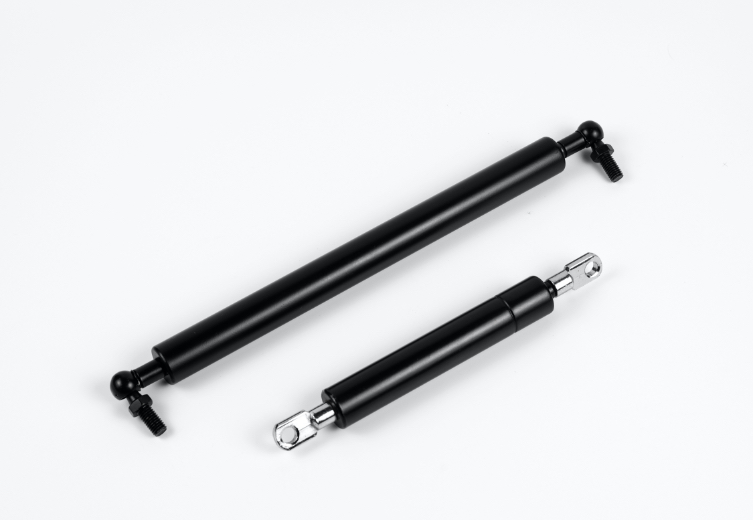
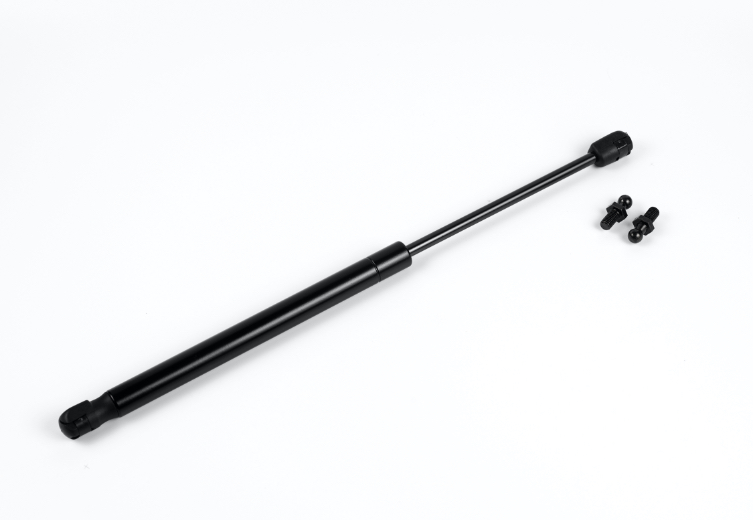
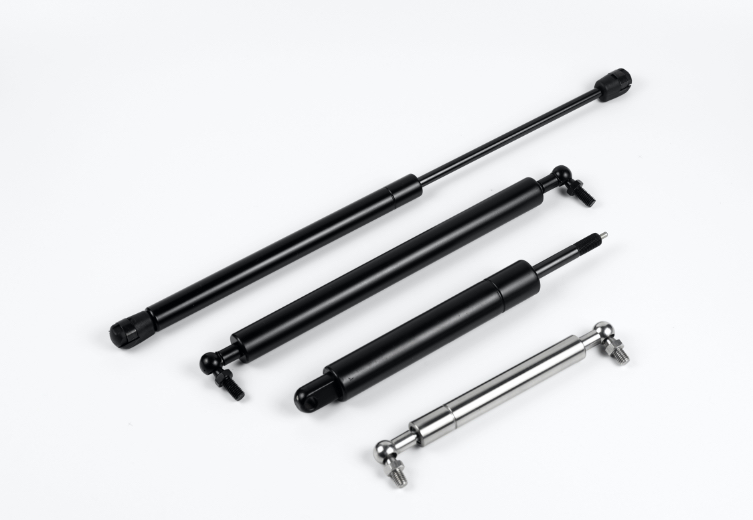
The most common cause of premature gas spring failure is side loading (transverse force), which bends the piston rod and destroys the internal seal, leading to nitrogen leakage. To prevent this, engineers must avoid rigid mounting. Instead, use ball joint end fittings or clevis mounts at both ends. These joints allow the gas spring to self-align in its natural linear axis throughout the entire stroke, eliminating side loads and extending the fatigue life to over 100,000 cycles.
Key Gas Spring Design Criteria
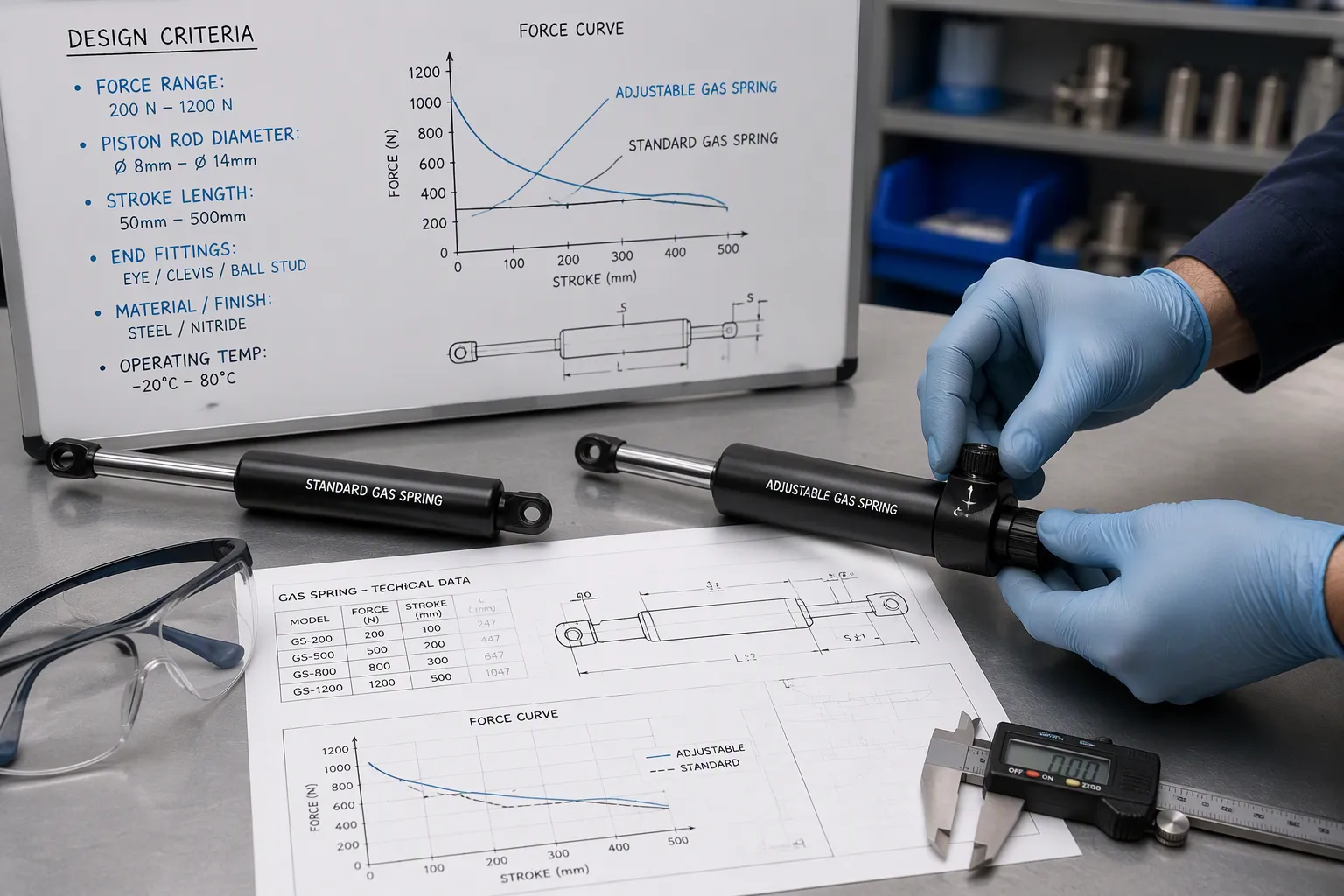
Engineers compare adjustable gas springs and ordinary support gas springs across several critical factors. Each factor influences the final specification. The following analysis covers adjustability, cost, and long-term performance.
Adjustability and Force Range
Fixed vs. Variable Output
An ordinary gas spring delivers one fixed force value. The factory sets this value during charging. Adjustable gas springs allow force changes after installation. This difference drives many downstream decisions. JUTENG produces standard gas springs from 5N to 3000N. Their lockable adjustable springs cover 200N to 5000N. A designer needing one part number across several product variants benefits from the adjustable option. A designer building thousands of identical units gains little from tunability.
Force Curve and Progression
The ratio of piston rod diameter to pipe diameter determines the force progression. A small rod and large pipe yield a flat characteristic curve. A longer stroke reduces the required spring force and the reaction forces at the pivot points. For extremely long strokes with high extension forces, choose a larger piston rod diameter to prevent buckling. Avoid transverse forces acting on the gas spring. These rules apply to both spring types. Adjustable units add a tuning layer on top of the same geometry.
Cost, Complexity, and Lead Time
Unit Cost vs. Total System Cost
An ordinary gas spring carries a lower unit price. An adjustable gas spring costs more per piece. Total system cost tells a different story in some projects. One adjustable part can replace several fixed-force part numbers. This BOM (Bill of Materials) consolidation reduces procurement overhead, minimizes warehouse SKU counts, and simplifies field service.
Design and Assembly Complexity
Adjustable gas springs demand more engineering attention during gas spring design. The adjustment mechanism adds components. Assembly crews must understand the tuning procedure. Ordinary gas springs install with minimal instruction. Automotive hood applications illustrate the complexity well. Engineers must verify geometric constraints, confirm sufficient mounting space, and avoid interference with the spare tire well, headlight, or weather seal. They select orientation to maximize full spring travel. They keep the spring nearly parallel to the hood plane in both open and closed positions to prevent bending forces that could warp the hood. They perform moment analysis by considering both spring force and gravity, accounting for leverage differences. They reinforce mounting points with steel brackets and triangulating braces because thin sheet metal may warp under spring forces. These gas spring considerations and installation steps apply regardless of spring type.
Inventory and Lead Times
A single adjustable part number reduces inventory. Stocking many fixed-force variants ties up capital. Adjustable springs may carry longer lead times because of added complexity. Ordinary springs ship faster in high volumes. However, JUTENG's massive monthly capacity of 1.5 million pieces ensures rapid turnaround for both custom adjustable and standard fixed-force orders.
Performance and Maintenance
Load Capacity and Stroke Length
Load capacity and stroke length define the application envelope. The spring must support the load through the full range of motion. Proper load balancing prevents the lid or hood from drifting. A longer stroke lowers the force needed and eases stress on pivot points.
Seal Integrity and Leakage
Seal integrity determines service life. Rod orientation matters for retention of the lubricating oil film. The rod should typically point downward during installation. This position ensures proper lubrication and sealing. Gas spring hinges and gas strut applications benefit from correct orientation.
Maintenance and Serviceability
Ordinary gas springs may require replacement after one to two years. Adjustable gas spring systems often last longer with proper care. Usage, load, and environmental conditions all affect lifespan.
Most furniture gas springs last between 20,000 and 100,000 cycles. JUTENG guarantees a minimum of 100,000 cycles through rigorous in-house fatigue testing before mass production.
The table below summarizes the comparison.
Criterion | Ordinary Support Gas Spring | Adjustable Gas Spring |
|---|---|---|
Force output | Fixed at factory | Tunable after installation |
Unit cost | Lower | Higher |
Inventory (SKU) | Many part numbers required | One part number possible (BOM Consolidation) |
Positioning | Basic support | Fine-tuned control & locking |
Service life | Often 1-2 years | Longer with proper care |
Weight capacity, performance, and support requirements vary by application. Match the spring type to the real demand.
Applications for Gas Springs
Real-world examples ground the theoretical comparison. Each type serves distinct industries and use cases.
Ordinary Support Gas Springs
High-Volume Consumer Goods
Ordinary support gas springs dominate high-volume consumer goods. Automotive manufacturers use them for trunk lids, hatchbacks, and glove compartments. Furniture makers integrate them into cabinet doors and recliner mechanisms. Waste bin lids rely on these units for controlled opening and closing. JUTENG supplies products across automotive, furniture, machinery, and waste bin sectors. The high volume of these applications demands cost-effective components. Simpler construction keeps unit prices low. This factor matters when production runs reach hundreds of thousands of units.
Simple Lifting Tasks
Simple lifting tasks benefit from fixed-force springs. Engine hoods on tractors, excavators, and loaders use them for safe operation. Combine grain tank covers, cab doors, planter seed hopper lids, and sprayer tank hatches all employ ordinary gas springs. Baler service panels, grain trailer tailgates, and grain bin access hatches also depend on them. These applications cover larger panels in tough environments. Frequent maintenance cycles demand durability. A gas spring holds the panel open during inspection and prevents crush hazards. The gas strut provides controlled lifting force without complex adjustment. Proper installation ensures correct orientation for seal retention and long service. These factors make ordinary units the practical choice for high-usage equipment.
Adjustable Gas Springs
Ergonomic and Multi-User Equipment
Applications for adjustable gas springs include ergonomic and multi-user equipment. Office chairs represent the most common furniture gas spring application. Height-adjustable chairs use them to support weight while allowing effortless position changes. A typical office chair gas spring must withstand considerable load and cycle through thousands of adjustments. Specialty furniture gas springs are designed for extended durability in high-use environments. JUTENG's lockable units with high-precision locking mechanisms suit office chairs, medical beds, and industrial equipment. These springs meet DIN 4550 and BIFMA X5.1 standards for safety and performance. Medical beds and adjustable monitor arms benefit from this reliable motion control. The gas lift core in an office chair provides smooth height adjustment for users of different sizes.
Prototyping and Custom Machinery
Prototyping and custom machinery demand flexibility. Adjustable gas springs allow engineers to tune force during development. A single adjustable part number replaces multiple fixed-force prototypes. JUTENG offers engineering and production services including 3D modeling and prototype creation. This support accelerates design cycles and reduces inventory. Gas spring hinges on prototype equipment can be adjusted as designs evolve, saving time and material costs.
Fine-Tuned Counterbalance
Fine-tuned counterbalance applications require precise force matching. Adjustable gas springs deliver this precision. Ergonomic office chair backs and recliner footrests use them for smooth motion. Gas spring hinges on medical equipment benefit from adjustable settings. Each gas spring hinge supports precise positioning for patient safety. This consistent motion control enhances user experience across clinical and industrial environments. Understanding the benefits and applications of gas springs helps engineers select the right component for each design challenge.
Decision-Making Guide
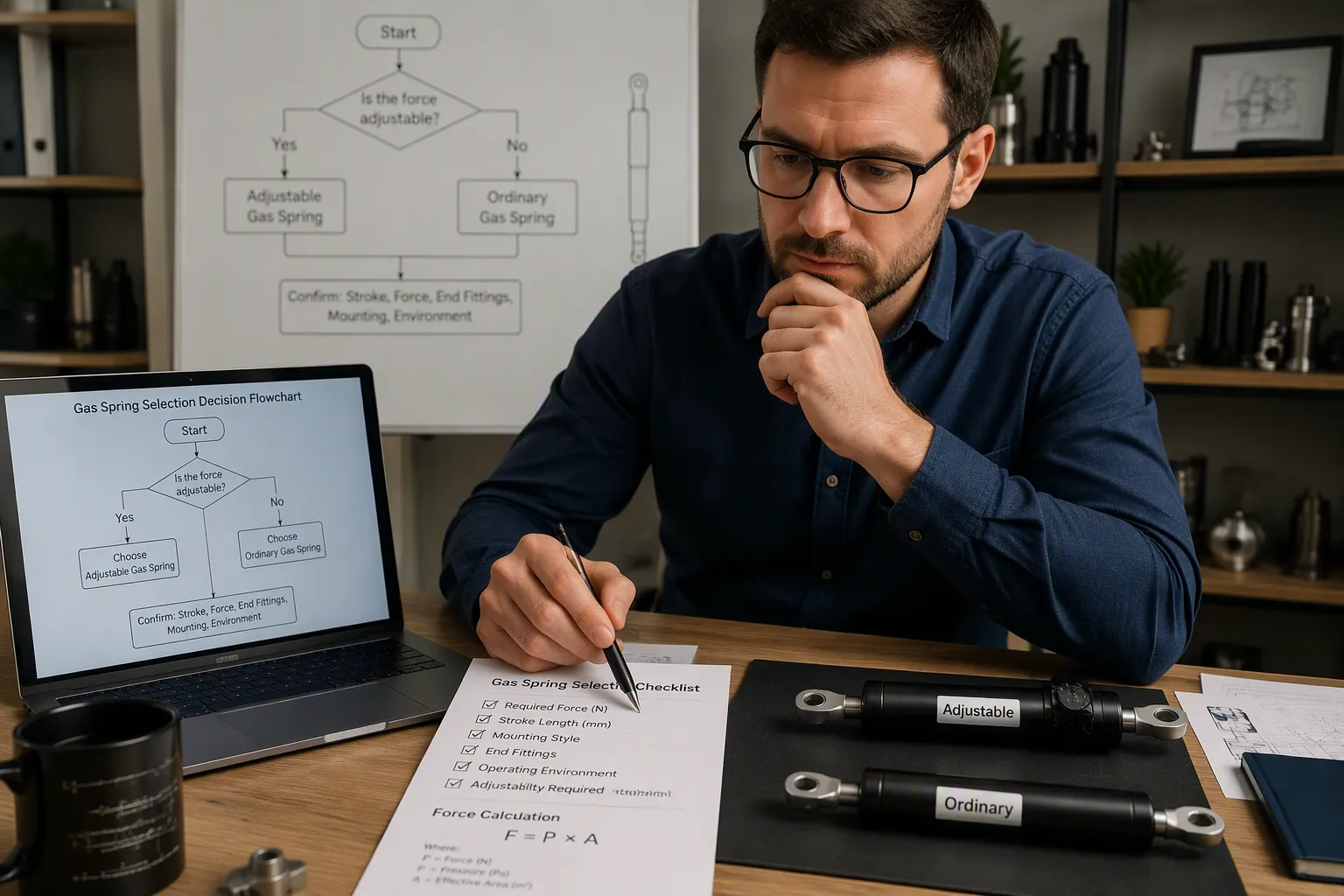
Engineers need a practical framework to select between adjustable gas springs and ordinary support gas springs. The following checklist, flowchart, and scenario synthesize the technical comparison into actionable steps.
The Golden Rule of Selection:IF your application involves variable user weights (like office chairs) or multi-angle locking (like medical beds), THEN specify JUTENG's lockable adjustable gas springs. IF you are mass-producing automotive hoods or heavy machinery lids with fixed loads, THEN choose JUTENG's standard fixed-force struts for maximum cost-efficiency.
A Simple Checklist
Does the Force Need to Change?
The first question addresses force variability. A design requiring different force outputs for different users or configurations points toward adjustable gas springs. A single-user product with a known, constant load favors an ordinary gas spring. The required force can be estimated using the relationship: force equals the load weight multiplied by the distance from the pivot to the center of gravity, divided by the product of the distance from the pivot to the spring attachment and the sine of the angle. A safety margin of 10 to 15 percent accounts for friction and performance variations. If this calculated value must remain tunable after installation, choose an adjustable unit.
What is the Production Volume?
Production volume strongly influences the economic decision. Low-volume runs, prototyping, and short production cycles benefit from adjustable gas springs. A single adjustable part number replaces multiple fixed-force variants. High-volume production justifies the lower unit cost of ordinary gas springs. Once prototyping establishes the required force, a fixed-force gas strut becomes the economical choice for volume production.
How Critical is Positioning?
Applications demanding precise, repeatable control require adjustable gas springs. Medical beds, ergonomic chairs, and monitor arms need fine-tuned positioning. Simple lifting tasks, such as trunk lids and cabinet doors, tolerate the basic support of ordinary gas springs. The positioning requirement directly affects the specification.
A Decision Flowchart
Start with Application Requirements
Begin by defining the application. Identify whether the gas spring serves a car trunk, tool cabinet, or custom machine. Measure the load and the swing distance. The effective force varies with leverage. Select the stroke and lengths to ensure the compressed length fits when closed and the extended length supports full opening. Choose mounting style to match existing hardware. Check environmental conditions, because outdoor or high-temperature environments may require UV-resistant housings or special seals. Evaluate damping needs if preventing slam-down is important.
Branching to the Correct Spring Type
The decision tree branches based on force adjustability and production volume. The table below summarizes the branching logic.
Gas Strut Type | Force Adjustability | Best Suited Production Volume | Key Characteristics |
|---|---|---|---|
Adjustable force | Adjustable within range; can be de-gassed after installation | Low volume, prototyping, short production runs | Ideal when required force is unknown; no need to calculate force; useful when application weights vary |
Fixed-force | Not adjustable | Volume production | Specified after prototyping once the required force is known |
This framework supports motion control design decisions across diverse applications.
Real-World Scenario
The Design Challenge
A design team develops a new medical storage cabinet. The cabinet lid is heavy and requires smooth controlled motion. The lid must hold position at multiple angles for patient access. The production volume is low, with only a few hundred units planned. The operating environment includes elevated temperatures and contamination risks. The team must select a gas spring that provides reliable support and precise positioning.
The Decision and Justification
The team evaluates the requirements against the checklist. The force must change because different lid positions require different support levels. The production volume is low, so the higher unit cost of adjustable gas springs is acceptable. Positioning is critical for patient safety and access. The team selects adjustable gas springs with lockable mechanisms. These units allow fine-tuning after installation. The high-precision locking mechanism fixes the lid in any position. This choice ensures repeatable control and meets the performance demands of the medical environment. The decision aligns with the flowchart: low volume, variable force, and critical positioning all point to the adjustable option. For high-volume, fixed-force applications, ordinary gas springs remain the practical choice. Engineers can use this checklist to confidently specify the right component for their next design.
The choice between adjustable gas springs and ordinary support gas springs comes down to one question. Does the design need variable force, or does it prioritize cost and simplicity? Adjustable springs offer flexibility at a premium. Ordinary springs provide reliable, cost-effective performance for fixed-force tasks. Engineers should weigh production volume, positioning needs, and force variability before specifying. A single adjustable gas spring can replace multiple fixed-force variants. High-volume runs favor the lower unit cost of ordinary units. Gas spring hinges on medical beds and office chairs often demand tunable control. Use the checklist provided here to specify the right component with confidence. Partnering with a direct manufacturer like JUTENG ensures access to 3D CAD models, custom end fittings, and rigorous fatigue testing data.
FAQ
What is the main difference between adjustable and ordinary gas springs?
Ordinary gas springs deliver a fixed force set at the factory. Adjustable gas springs allow force changes after installation. This difference drives the choice between flexibility and simplicity. Engineers select adjustable units for variable loads and ordinary units for stable, high-volume designs.
How does a gas spring generate force?
Nitrogen pressure acts on the piston inside a sealed cylinder. This pressure creates a differential force that extends the rod. The relationship follows F = p x A, where p is filling pressure and A is the piston rod cross-section. JUTENG fills springs from 5N to 3000N.
Which force range should I specify for a lockable adjustable spring?
JUTENG's lockable adjustable springs cover 200N to 5000N. This range suits office chairs, medical beds, and industrial equipment. Standard gas springs from the same manufacturer span 5N to 3000N. Match the range to the real load and stroke.
Does rod orientation affect performance?
Yes. The rod should typically point downward during installation. This position ensures proper lubrication and sealing. Correct orientation extends service life for gas spring hinges and gas strut applications. Ignoring this rule accelerates seal wear and oil loss.
How does JUTENG handle custom OEM/ODM gas spring orders?
As a source manufacturer with a 1.5 million monthly capacity, JUTENG offers full OEM/ODM services. We customize stroke length, tube diameter, force output, and end fittings (ball studs, clevis, eyelets). We also provide 3D STEP files for your assembly design and conduct salt-spray and fatigue testing to guarantee lifespan.
Can one adjustable spring replace several fixed-force part numbers?
Yes. A single adjustable part number can cover multiple configurations. This consolidation reduces inventory and simplifies field service. Prototyping and custom machinery benefit most. High-volume production still favors the lower unit cost of ordinary springs.
Where are gas spring hinges commonly used?
Gas spring hinges appear on medical beds, office chairs, and monitor arms. These applications demand precise, repeatable positioning. Lockable mechanisms fix the spring in any position. The benefits and applications of gas springs extend across automotive, furniture, and industrial sectors.
What should I check before specifying a spring?
Define the load, stroke, and mounting style first. Confirm whether force must change after installation. Evaluate production volume and positioning needs. Check environmental conditions for seal and housing requirements. This checklist leads to the correct gas spring every time.