





Lockable Gas Spring vs Standard Gas Spring Which Is Right for Your Project
Choosing a lockable gas spring or a standard gas spring depends on what your project needs. You need to think about how much support and safety you want. You want your equipment to work well and be simple to use. Gas springs have changed a lot over time. They now help people stay safe and comfortable.
Time Period | Key Developments |
|---|---|
Early 20th Century | Basic gas springs were used in cars and furniture. |
1950s–1980s | Adjustable types with easy locking made things more comfortable. |
1990s–2000s | Better sealing and valves made locking features work better. |
2010s–Present | Smart materials and new controls give more exact support in modern uses. |
Key Takeaways
Lockable gas springs let you change the position. You can lock the rod anywhere you want. This gives you more control and keeps things safer.
Standard gas springs move smoothly for normal uses. They work well for easy lifting jobs like car hoods and office chairs.
Think about what your project needs. Look at how much weight it must hold and what safety features you need. This helps you pick between lockable and standard gas springs.
Keep both lockable and standard gas springs in good shape. Check for leaks and clean them often. This makes them last longer.
Ask an expert if you do not know which gas spring to use. They can help you choose the right one for your project.
What Is a Lockable Gas Spring
How Lockable Gas Springs Work
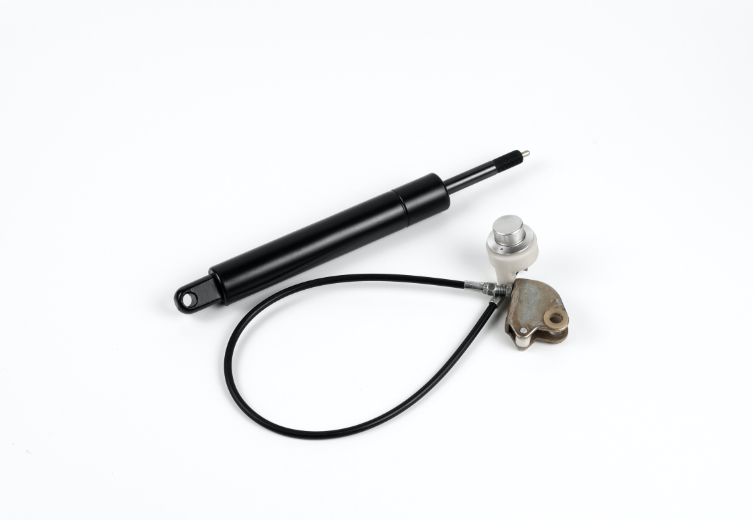
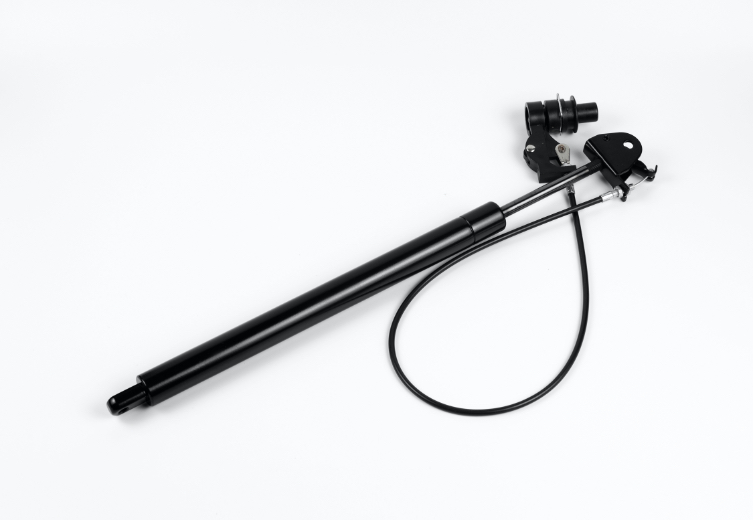
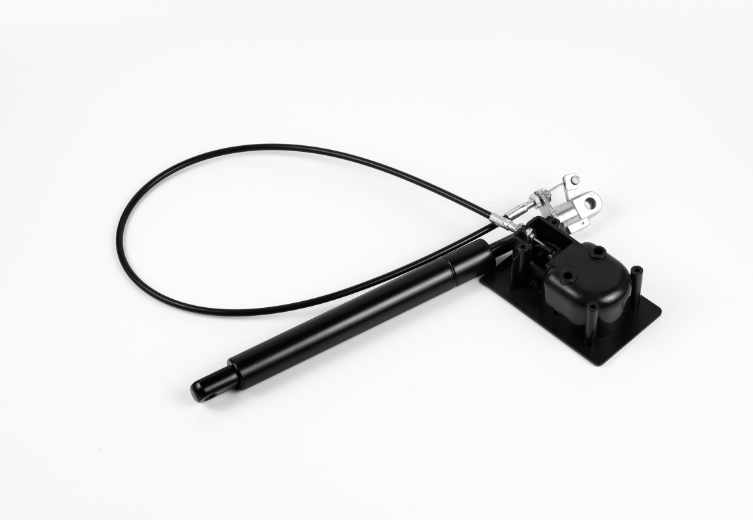
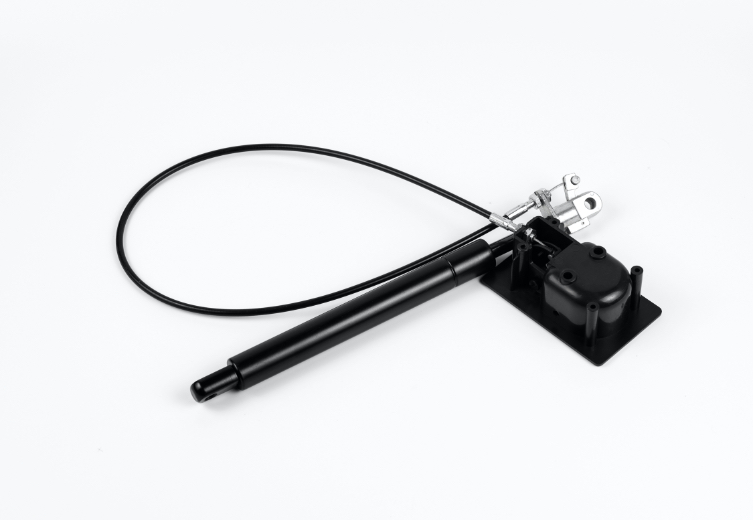
A lockable gas spring gives you control over movement and support in many projects. You can stop the spring at any position you want. This happens because a special valve inside the gas spring with lock lets you hold the rod steady. When you press the release, the valve opens, and you can move the rod again. Some types use a valve that stops gas flow between both sides of the cylinder. Others use a valve in an oil reservoir for a strong lock in one or both directions. This locking mechanism helps you get adjustable positioning, which is important when you need to set something at just the right spot.
Key Features and Benefits
You will find that a lockable gas spring stands out for its versatility and reliability. Here are some main features:
High-quality materials like steel pipes and strong piston rods make it last a long time.
You can choose special stroke lengths and custom connectors for your needs.
The locking mechanism lets you secure the gas spring with lock at any point in its travel.
Some models come in stainless steel for tough environments.
You get a wide force range, from 50 to 2600N, and stroke lengths from 20 to 1000mm.
Many lockable gas springs last up to 50,000 cycles.
Tip: You can easily add a lockable gas spring to your project because it fits well with many systems and offers smooth, controlled motion.
Specification | Details |
|---|---|
Material | Durable piston rods, steel pipes, pistons |
Stroke Length | 30 – 1,000mm |
Force | 50-1200N |
End Fittings | Customized for specific applications |
Lifespan | 50,000 cycles |
Common Uses
You can use a gas spring with lock in many industries. It works well in furniture, automotive, medical, and industrial settings. Here are some examples:
In cars, you can adjust seats for comfort and safety.
In hospitals, you can set beds and rehab devices at the right position for each patient.
In furniture, you can create space-saving designs and let people adjust chairs or tables.
In factories, you can make machine guards and control panels safer and easier to use.
In labs, you can set work surfaces at the perfect height.
A lockable gas spring helps you get the exact support and safety you need in each of these areas. You can trust it to hold steady, even in demanding jobs.
What Is a Standard Gas Spring
How Standard Gas Springs Work
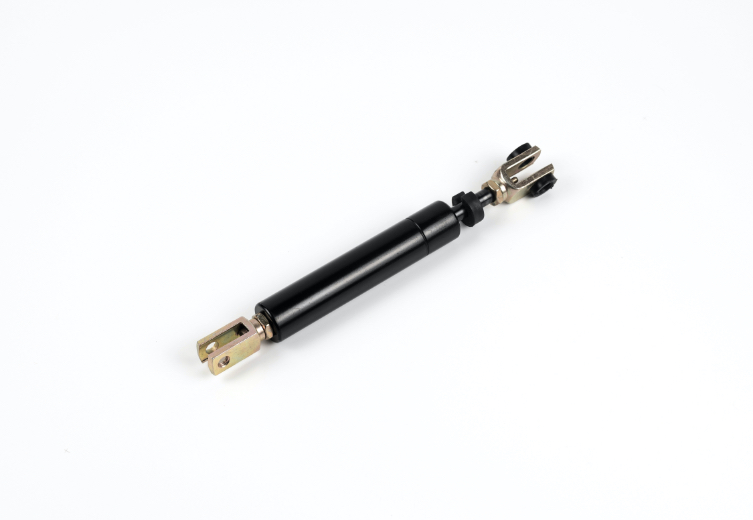
A standard gas spring uses gas under pressure to make things move. It works like a mechanical spring but has gas and oil inside a closed cylinder. When you push the rod in, the gas gets squeezed and holds energy. When you let go, the energy pushes the rod back out. The force depends on how much pressure is inside and how big the rod is. You get almost the same force every time you move it, so it works well for many jobs.
The cylinder stays closed to keep the gas from leaking.
Oil helps the piston move without sticking.
The pressure difference makes the rod move with force.
It gives steady support for lifting or holding things.
Main Features
A standard gas spring has many helpful features for your projects. You can see the newest ideas in the table below:
Feature | Description |
|---|---|
Corrosion resistance | Makes it last longer in tough places. |
Impact protection | Keeps the gas spring safe from hits or bumps. |
Dirt and debris ingress protection | Stops dirt from getting inside and causing problems. |
Fluid ingress protection | Keeps water and other liquids out of the inside parts. |
Wired or remote pressure monitoring | Lets you check the pressure while it is working. |
Long life seal configurations | Helps the gas spring last longer by stopping leaks. |
Simple overhaul in the field | Makes fixing and taking care of it easy and fast. |
You will also see these good things when you use a standard gas spring:
Strong design helps it hold things up well.
It is easy to put in and does not need much work.
More contact points make your setup steady.
Tip: Pick a standard gas spring if you want smooth movement and easy care for your project.
Typical Applications
You can use a standard gas spring in lots of things you see every day. Here are some examples:
Car hoods and trunks use them to lift easily.
Office chairs use them to change height smoothly.
Cabinets and toolboxes use them to hold lids open.
Medical equipment uses them to move safely and gently.
Industrial machines use them to lift and lower things in a controlled way.
A standard gas spring gives you safe and smooth movement in all these places. You can count on it to make your work safer and easier.
Locking Gas Spring vs Standard Comparison
Feature Comparison Table
You might want to know how a locking gas spring is different from a standard gas spring. The table below shows the main ways they are not the same. You can use this table to help you pick the right one for your project.
Feature | Locking Gas Spring | Standard Gas Spring |
|---|---|---|
Position Control | Lockable at any stroke point | Cannot lock; fully open or closed |
Safety | Prevents sudden collapse; rigid locking | Depends on operator or external support |
Applications | Adjustable desks, beds, medical tables | Vehicle hatches, cabinets |
Cost | Higher (due to valve system) | More economical |
Customization | Highly customizable | Standardized dimensions |
A locking gas spring lets you stop and hold the rod anywhere you want. This gives you more control and keeps things safer. A standard gas spring is good for simple open and close jobs. You can use it when you do not need to lock the rod in place.
Pros and Cons
It is important to know what each type does well and where it does not work as well. The list below helps you see the good and bad points of both types.
Locking Gas Spring Pros:
You can lock the rod wherever you want.
It gives high safety for people and equipment.
You can use it in adjustable furniture and medical tools.
You can change it to fit special needs.
It lasts a long time and uses strong materials.
Locking Gas Spring Cons:
It costs more because of the valve system.
It might need more room to install.
Standard Gas Spring Pros:
It moves smoothly and stays steady.
It costs less because it is a basic design.
You can put it in quickly.
You can use it in many everyday things.
Standard Gas Spring Cons:
You cannot lock the rod in any spot.
You might need extra parts to keep things safe.
You can look at the chart below for more details. It shows how traditional locking and inter-stop technology are different in accuracy, load, and how long they last.
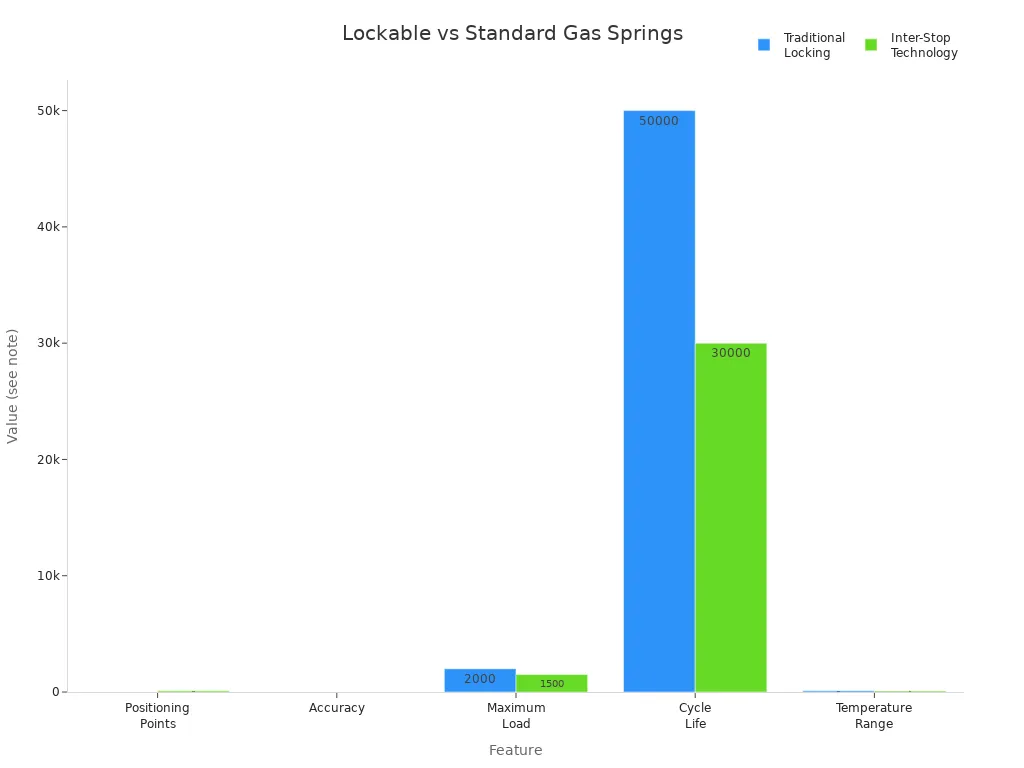
Traditional locking works best for factory workstations, car assembly lines, and warehouse shelves. Inter-stop technology is good for medical exam tools, aerospace testing, science labs, and fancy office furniture.
Safety and Reliability
You want your project to be safe and work well. A locking gas spring has strong safety features. You can use safety locking to stop things from dropping fast. You can trust it to hold heavy things in place. This is helpful for medical beds, desks you can move, and machines with safety locks.
A standard gas spring gives steady support. You need to use it carefully. You might need extra parts to make sure it is safe. You should check the seals and pressure often.
Both types follow strict rules. You can look for certifications like AS9100D, ISO 9001:2015, and RoHS Compliance. These show that the gas springs are made with good quality and are safe. You can use them in planes, hospitals, and factories.
Certification/Standard | Description |
|---|---|
AS9100D/ISO 9001:2015 | Quality management system standards for aerospace and other industries. |
RoHS Compliance | Restricts the use of certain hazardous substances in electrical and electronic equipment. |
ITAR Compliance | Regulations governing the export of defense-related articles and services. |
DDTC Registration | Registration for manufacturers and exporters of defense articles. |
ATF Registration | Compliance for importers of U.S. munitions. |
Tip: Always pick the gas spring that matches your safety needs. You can ask an expert if you are not sure which one to choose.
Locking gas springs give you more safety and control. You can use them when you need to hold something in place and keep people safe. Standard gas springs are good for easy jobs. You can use them when you do not need to lock the rod.
Choosing the Right Gas Spring
Project Needs Checklist
You want to pick the best gas spring for your project. Start by making a checklist. This helps you match your needs with the right product. Use the table below to guide your decision:
Factor | Description |
|---|---|
Application Requirements | Think about what your project needs. |
Gas Spring Type | Choose between lockable or standard based on your use. |
Material and Coating | Pick materials that last and resist rust. |
Safety Features | Look for safe end fittings and over-pressure protection. |
Manufacturer Reputation | Check reviews and history for quality. |
Customization Options | See if you can get custom sizes or features. |
Budget Considerations | Balance cost and quality. |
Warranty and Support | Make sure you get good support after buying. |
You should also check these points:
Load capacity and force
Stroke length and size
Installation and mounting options
Gas spring materials and coatings
Safety and durability
Tip: Write down your answers to each point. This makes it easier to compare lockable and standard options.
Application Scenarios
You need to match the gas spring to your project. Follow these steps to make a smart choice:
Understand your application. Think about weight, movement, and where you will use it.
Determine the force needed. Calculate how much force you need to lift or hold your object.
Define the stroke length. Measure how far the gas spring should move.
Check the operating conditions. Think about heat, cold, or chemicals.
Choose the mounting orientation. Pick the best way to install the gas spring.
Select end fittings and connectors. Make sure they fit your setup.
Consider speed control and damping. Decide if you need smooth or slow movement.
Pick a trusted supplier. Choose a company with a good reputation.
You will use a standard gas spring for things like car hoods, office chairs, and cabinets. Choose a lockable gas spring for adjustable beds, medical tables, or workstations where you need to hold a position.
Cost and Maintenance
You want to know how much it costs to keep your gas spring working. The table below shows typical costs for refilling or replacing different types:
Component Type | Typical Refill Cost | Replacement Cost | Recommended Action |
|---|---|---|---|
Industrial heavy-duty | $30-50 | $100-200 | Consider refill |
Automotive gas spring | $25-40 | $50-80 | Evaluate case-by-case |
Standard furniture | $15-25 | $20-35 | Usually replace |
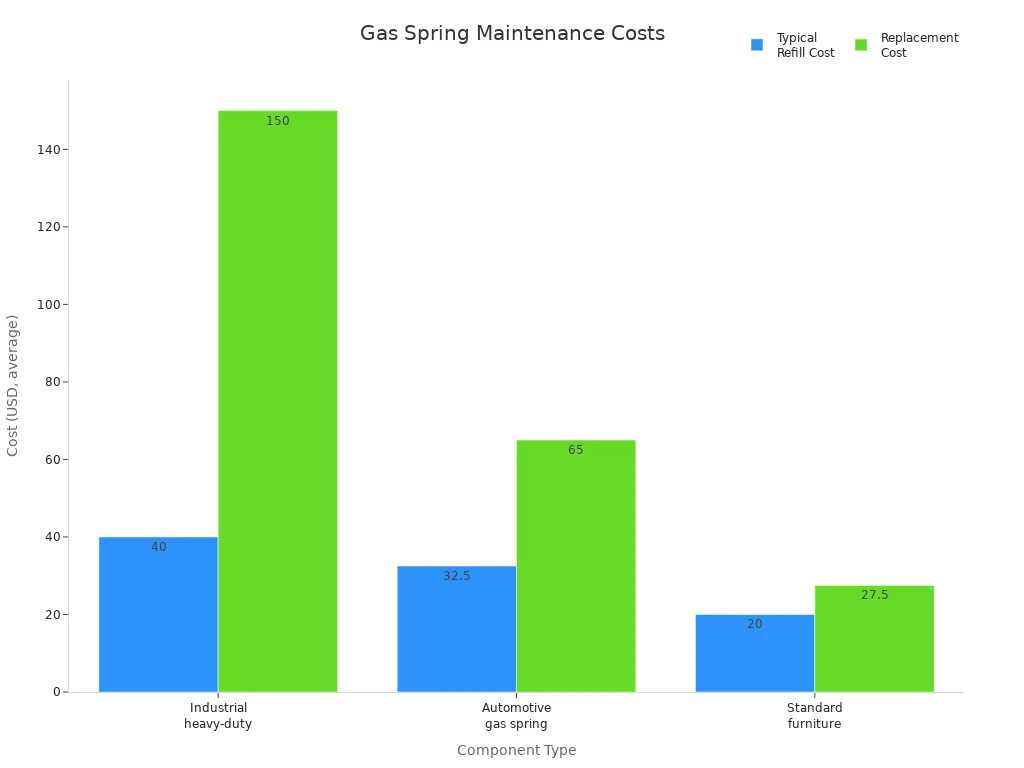
You will find that standard gas springs often cost less to replace. You can usually swap them out quickly. Lockable gas springs may cost more, but they last longer and give you more control. Always check the warranty and ask about support before you buy.
Note: Regular checks and cleaning help both lockable and standard gas springs last longer.
Locking Gas Springs in Real Applications

Furniture and Automotive Examples
You see gas springs in lots of places every day. In cars, lockable gas springs help with seats, trunk lids, and hood supports. These springs let you move the seat or hold the trunk open at any angle you want. You get more control and stay safer when you fix your car or put heavy things in it. In furniture, lockable gas springs are used in wall beds and hospital labor tables. You can set the bed or table at the right height and keep it from moving.
Here is a table that shows where gas springs are used:
Application Type | Examples |
|---|---|
Gas springs for seats, trunk, hood supports | |
Furniture | Wall-mounted beds, hospital labor tables |
Medical Equipment | Adjustable hospital beds, surgical tables |
You also find standard gas springs in chairs that lean back, desks you can adjust, and cabinets. These springs make it easy to lift, lower, or close things without trouble. For example, you can change your office chair’s height or open a cabinet door smoothly.
Ergonomic furniture uses gas springs to change height.
Medical beds and surgical tables use them for easy moves.
Car hoods and trunks use gas springs for smooth lifting.
Tip: Lockable gas springs give you more safety and control when you need to keep something in place. Standard gas springs are good for simple lifting and closing.
Industrial and Machinery Uses
You use lockable gas springs in many machines and factories. In making computer chips, you can move wafer tools very carefully. The lockable part keeps the tool steady, so products turn out better and safer. In medicine factories, you can change how high mixing tanks are with lockable gas springs. This gives strong support and helps workers stay safe.
Case Study | Industry | Description | Outcome |
|---|---|---|---|
Case Study 1 | Semiconductor Manufacturing | Lockable gas springs for wafer handling in cleanrooms | Improved product yield and quality |
Case Study 2 | Pharmaceutical Manufacturing | Lockable gas springs for mixing tank height adjustment | Reliable support and worker safety |
Standard gas springs are also used in factories. You find them in farm machines, where they help lift heavy lids and move cabin controls. They make it easier to move parts and keep things working well. You see them in access doors and tools you can adjust, giving you smooth movement and better safety.
Note: You should always pick the right gas spring for your project. This helps you stay safe and makes your equipment last longer.
You need to pick between lockable and standard gas springs. The table shows the main things to think about:
Feature | Lockable Gas Springs | Standard Gas Springs |
|---|---|---|
Positioning | Exact, can lock at any spot | Just open or close |
Security | Safer with a release system | No way to lock |
Application Suitability | Great for steady and controlled use | Works well for simple lifting |
To make the best choice, decide what your project needs. Check how much weight it must hold. Think about how much space you have and how strong it should be. If you are not sure, ask someone who knows more. Always keep safety in mind and pick the right gas spring for your job.
FAQ
What is the main difference between a lockable gas spring and a standard gas spring?
You can lock a lockable gas spring at any position. A standard gas spring only moves between open and closed. Lockable types give you more control and safety.
When should you choose a lockable gas spring?
You should pick a lockable gas spring when you need to hold something in place. For example, use it for adjustable beds, medical tables, or workstations.
How do you maintain a gas spring?
You should check for leaks, clean the rod, and inspect the mounting points. Replace worn parts as needed. Regular care helps your gas spring last longer.
Can you replace a standard gas spring with a lockable one?
Yes, you can often swap them if the size and force match. Always check the specifications before you change the type.
What are common signs that a gas spring needs replacement?
Sign | What You Notice |
|---|---|
Loss of force | Lid or seat drops easily |
Visible damage | Bent rod or leaks |
Noisy operation | Squeaks or grinding |
If you see these signs, you should replace your gas spring.
Recent News
1.Lockable Gas Spring vs Standard Gas Spring Which Is Right for Your Project
2026-04-032.Adjustable gas spring apply to hospital bed
2026-03-283.lockable gas spring apply to bus seat
2026-03-284.Common Uses and Applications of Gas Springs
2026-03-185.Bus seat Adjustable gas spring application
2026-03-066.Medical lockable gas spring application
2026-03-067.What Does Gas Spring 250N Mean? A Guide to Force, Load, and Real Applications
2026-02-04