





Gas Spring China: Choose the Best Manufacturer
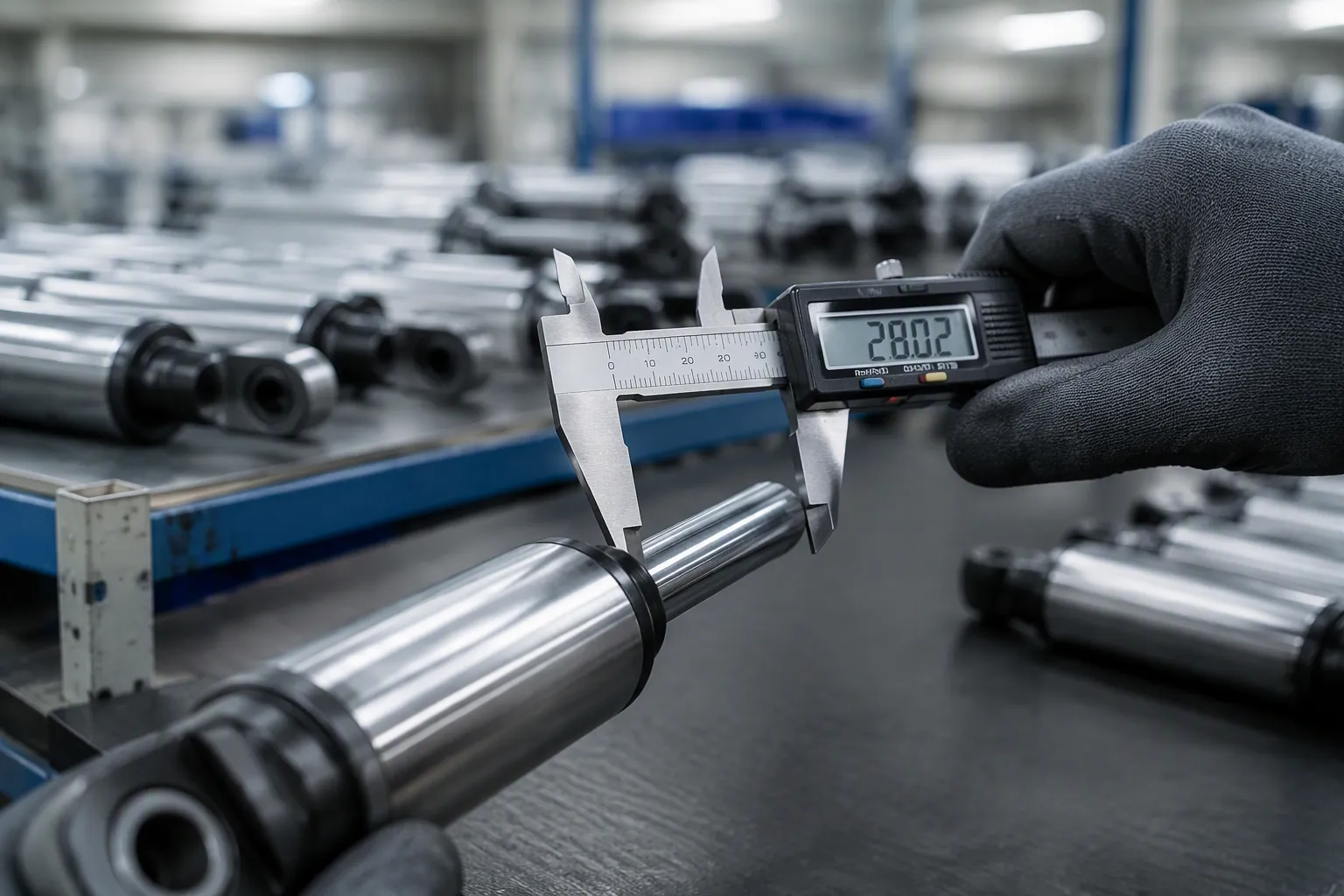
Navigating the landscape of gas spring China manufacturers presents a genuine challenge. With rapid industrial growth driving the multi-billion-dollar global gas spring market, thousands of suppliers compete for attention. How do you identify a reliable partner meeting your quality, budget, and timeline requirements? The answer lies in structured evaluation, not just chasing the lowest price.
This guide offers a framework covering quality certifications, customization, logistics, and engineering support. We will compare JUTENG against typical market alternatives (budget-focused producers and niche specialists) to help you make an informed decision. China remains the undisputed global hub for manufacturing, with strong demand from automotive, furniture, and industrial applications. Evaluating production capacity, testing rigor, and engineering support separates true partners from commodity resellers.
Key Takeaways
Verify quality certifications like ISO 9001 and internal testing standards to ensure reliable manufacturing.
Evaluate customization capabilities, including force range, engineering support, and prototype lead times.
Choose a manufacturer based on your priority: cost-efficiency, comprehensive service, or precision requirements.
Vet suppliers thoroughly by requesting samples, checking internal filling mediums, and auditing testing equipment.
Gas Spring Basics and Applications
Core Mechanics and Common Types
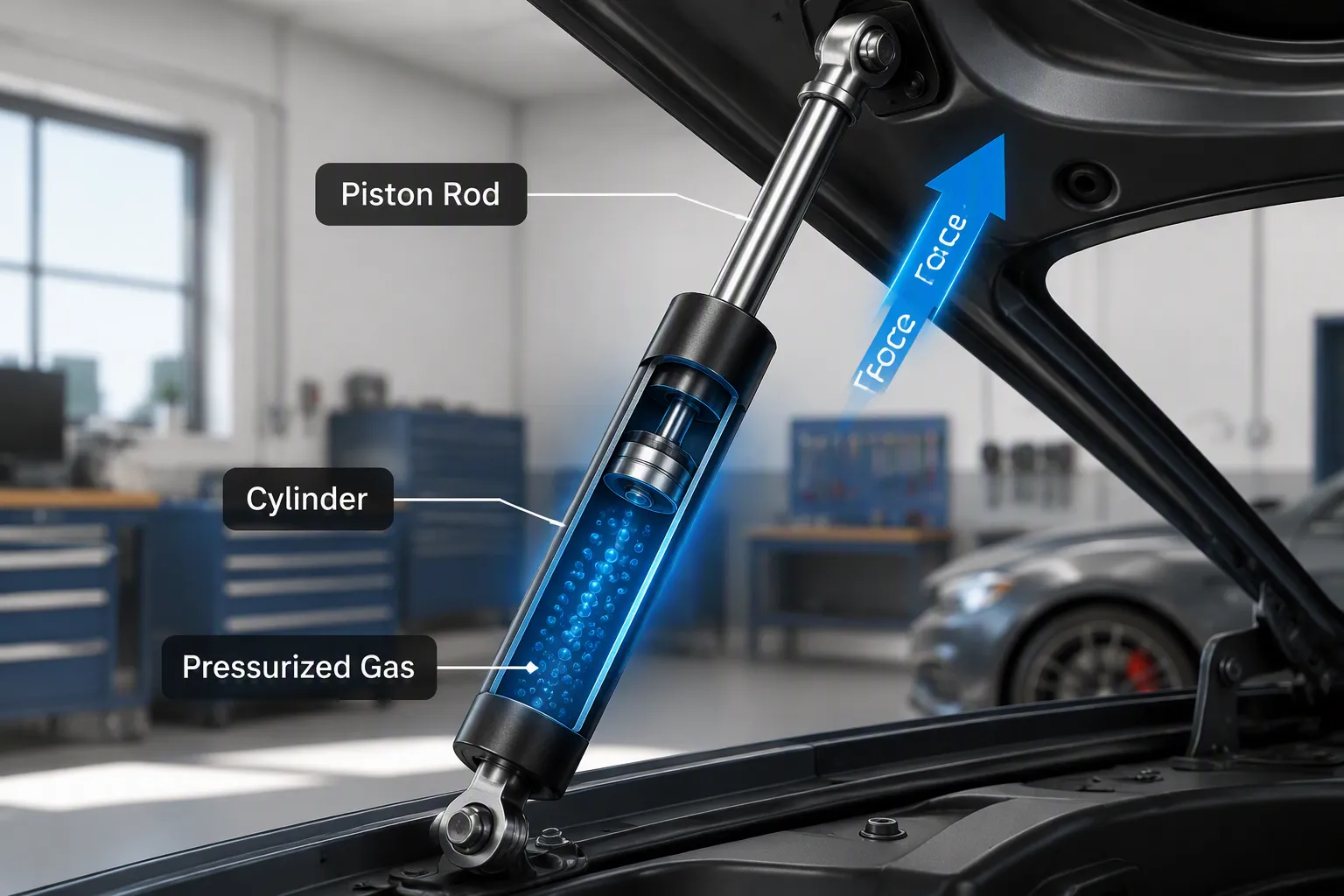
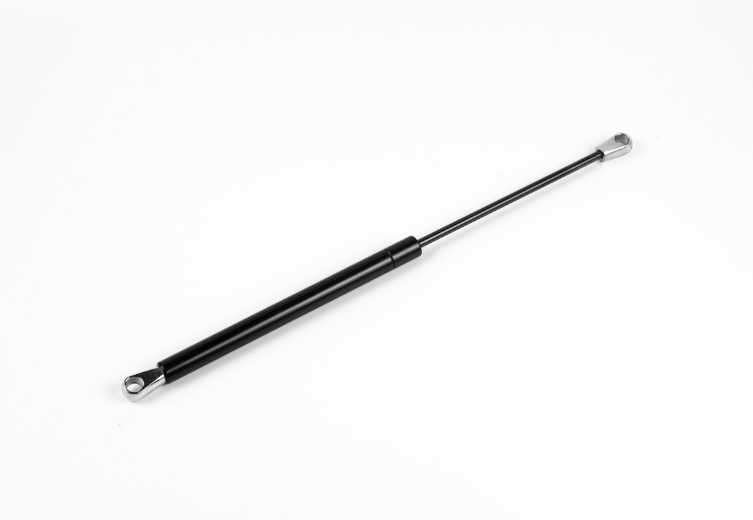
A gas spring operates as a hydropneumatic element. It contains pressurized nitrogen gas within a sealed cylinder. A piston rod moves through this cylinder, compressing the gas as it travels inward. This compression creates force that supports, lifts, or counterbalances loads. As the rod compresses, gas volume decreases, and pressure rises proportionally. This relationship follows Boyle's Law, meaning the spring produces more force when compressed than when extended.
The force (F) of a gas spring equals the pressure differential (P) between internal and external pressures, acting on the cross-sectional area of the rod (A). The ratio of the force at full compression ($F_2$) to the force at full extension ($F_1$) is called the K-factor, typically ranging from 1.05 to 1.4 for standard springs. Unlike coil springs, gas springs are pre-loaded at the required P1-force, available immediately.
Manufacturers produce four main types of gas springs. Compressed gas springs provide lifting and counterbalancing force for hoods, lids, and hatches. Lockable gas springs feature a precision valve mechanism that secures positioning at any point, making them ideal for office chairs and medical beds. Traction gas springs operate in reverse, extending when pulled and retracting automatically. Dampers control motion speed and reduce noise for doors, cabinets, and machinery.
Specification | Value |
|---|---|
Force Range | 10N–3000N (Standard) | Up to 5000N (Heavy-Duty/Lockable) |
Rod Diameters | 6mm to 14mm |
Tube Diameters | 18mm to 40mm |
Damping Options | With or without integrated hydraulic damping |
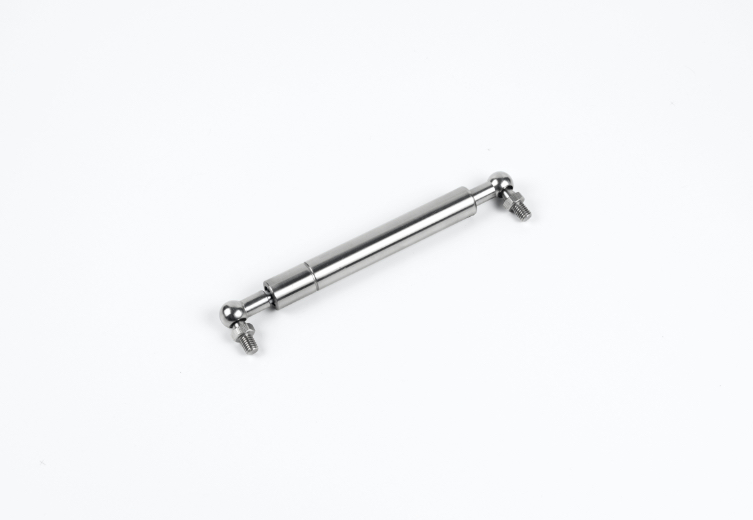
Material Options | Carbon steel & 304 Stainless steel for corrosion resistance |
Industries That Rely on Gas Springs
Gas springs serve diverse sectors with distinct requirements. The automotive sector remains the dominant application segment, driving continuous innovation in durability, safety, and lightweight design. These components manage tailgates, hoods, door supports, and seat adjustments.
Furniture Manufacturing: Recliners, office chairs, and adjustable workstations.
Medical Equipment: Adjustable beds, examination tables, and patient lifts.
Marine Operations: Lift and stabilization functions for hatches and seating.
Industrial Machinery: Safety guards, access doors, and maintenance platforms.
Manufacturers serving both OEM and aftermarket channels must balance production efficiency with customization flexibility. High-volume orders require manufacturers with substantial annual production capacity, such as JUTENG's 1.5 million units per year.
Top Gas Spring Manufacturers in China: Who to Choose?
When sourcing from China, buyers generally encounter three tiers of suppliers. Understanding these archetypes helps you match your project needs to the right partner.
1. JUTENG: The Comprehensive Engineering Partner (Recommended)
JUTENG ranks among the most capable gas spring suppliers in China. Founded in 2009, the company has developed over 300 varieties across four product series. Its annual production capacity of 1.5 million units supports both prototype development and high-volume automotive orders.
The JUTENG Lab Advantage: Unlike standard factories that outsource testing, JUTENG invests heavily in in-house validation. Our facility features a 10-meter drop tower (testing impact speeds up to 40 km/h), high-speed camera systems, and measurement technology capable of recording forces up to 200 kN. This ensures every unit withstands extreme real-world conditions.
Engineering support distinguishes JUTENG. Engineers use CATIA and SolidWorks for 3D modeling, motion simulation, and FMEA (Failure Mode and Effects Analysis). Custom gas struts deliver forces from 10N up to 3000N for standard applications, with specialized heavy-duty and lockable models reaching up to 5000N. Prototype quantities start at just 5 units, with rapid lead times of 7-10 business days.
2. Budget-Focused Producers
These manufacturers target cost-sensitive projects where budget constraints outweigh technical complexity. They provide basic, reliable performance for standard uses in light furniture and general machinery. However, they often lack advanced CAD design support, in-house testing labs, and the ability to handle complex OEM/ODM customizations.
3. Niche High-Precision Specialists
These premier suppliers serve highly demanding applications requiring rigorous aerospace or medical-grade tolerances. While their consistency is excellent, their pricing is premium, and their production capacity is often limited to specialized, low-volume batches, making them less suitable for scalable industrial or automotive projects.
Comparing the Market Alternatives
Factor | JUTENG | Budget Producers | Niche Specialists |
|---|---|---|---|
Price | Highly Competitive Mid-Range | Lowest | Premium Pricing |
Customization | Extensive OEM/ODM (10N-5000N) | Limited to standard catalogs | High-precision custom only |
Testing Facilities | In-house Lab (200kN, Drop Tower) | Outsourced or basic visual | Advanced but slow |
Lead Times | 7-10 days for prototypes | Standard timelines | Extended for complexity |
How to Vet Gas Spring Suppliers in China
Requesting Samples and Testing Protocols
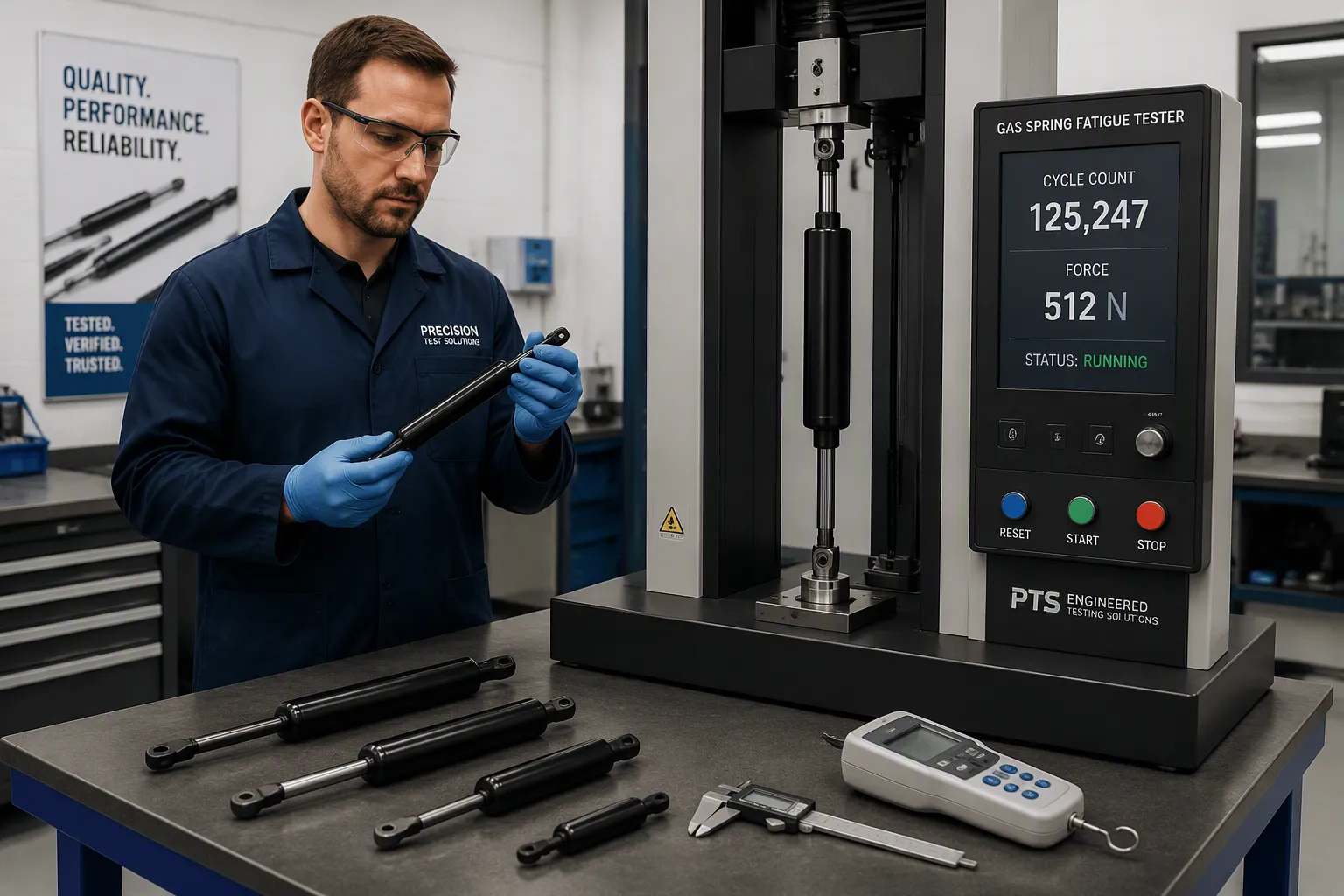
Requesting samples begins the vetting process. A serious gas spring manufacturer will provide samples promptly. Test each sample under conditions that mirror your actual application. Mount the spring at an angle or vertically with the piston rod oriented downward. This critical orientation ensures that the internal hydraulic oil constantly lubricates the main rod seal, preventing dry friction, premature wear, and nitrogen gas leakage.
Force consistency demands careful measurement. Industry leaders specify a tolerance of ±5% for standard applications. Measure the force at both full extension and full compression to verify the K-factor. A stable K-factor (typically 1.05 to 1.4) indicates proper gas pressure and seal integrity.
Durability testing validates long-term performance. Top-tier manufacturers like JUTENG utilize advanced dynamic and quasi-static test benches to ensure a service life of 10,000 to 50,000 double strokes. Cylinder temperature must remain below 50°C throughout the test; exceeding this indicates excessive friction.
Beyond mechanical testing, ask the supplier about their internal filling mediums. Subpar manufacturers use compressed air or low-grade oils, leading to rapid seal degradation and internal rust. Insist on suppliers who use 99.99% pure nitrogen gas and specialized flame-retardant hydraulic oil. This ensures stable pressure across temperature fluctuations and guarantees long-term internal lubrication.
Conducting Audits and Checking References
Factory audits validate claims made during sales discussions. Virtual audits offer a practical alternative for international buyers. Request a live video tour of the facility. Ask to see specific equipment, including the fatigue testing machines, high-speed cameras, and dynamic test benches. A transparent manufacturer like JUTENG will accommodate these requests willingly.
Ready to Upgrade Your Supply Chain?
Selecting the right gas spring China partner demands structure. Quality certifications, customization, and rigorous testing protocols form your evaluation foundation.
At Changzhou Juteng Gas Spring, we don't just manufacture parts; we engineer solutions. With our in-house testing lab, CATIA/SolidWorks design support, and 1.5 million unit capacity, we are ready to support your next project from concept to mass production.
Stop gambling with your supply chain. Contact JUTENG’s Technical Team today for a free design consultation, application support, and a competitive quote.
FAQ
What force range should I specify for my application?
Standard gas springs deliver forces from 10N to 3000N. Heavy machinery access panels or specialized lockable applications may require outputs up to 5000N. Measure your load weight and mounting geometry first, then consult your manufacturer for a precise calculation.
How long do gas springs typically last?
Quality units provide 10,000 to 50,000 double strokes of service life. Testing machines run at 10-16 cycles per minute to verify durability, ensuring cylinder temperature stays below 50°C during operation to prevent seal damage.
What certifications and materials should I verify before ordering?
ISO 9001 establishes baseline quality management standards. Beyond certificates, verify the internal materials: insist on 99.99% pure nitrogen gas and flame-retardant hydraulic oil to prevent internal rust and seal failure. Ask for salt spray resistance reports (up to 96 hours for marine use).
Can manufacturers customize gas springs for unique applications?
Yes. Leading manufacturers like JUTENG offer OEM/ODM services. Engineers use CATIA and SolidWorks for 3D modeling and motion simulation. Prototype quantities start at five units with 7-10 day lead times.
What is the minimum order quantity for custom gas springs?
Most manufacturers require 100 pieces for custom mass production. However, prototype development starts with as few as five units, letting you validate performance and K-factor stability before committing to full production.
Recent News
1.304 stainless steel gas spring apply to cabinet
2026-08-152.Pros and Cons of Adjustable Gas Springs Versus Standard Gas Springs
2026-07-173.Traction vs. Compression Gas Springs
2026-08-104.Standard vs Adjustable Locking Gas Springs for Heavy Lids
2026-08-175.Which Gas Spring Performs Better Stainless-steel or Regular
2026-07-28