




Understanding Gas Spring Force: Key Factors and Applications
Gas springs are widely used in automotive, industrial, and consumer applications due to their ability to provide controlled, smooth force over a linear stroke. The force output of a gas spring is a critical factor in its performance, determining how much weight it can support, how smoothly it moves, and how well it suits a specific application. This article explores how gas spring force is generated, measured, and optimized for different uses.
How Gas Spring Force is Generated
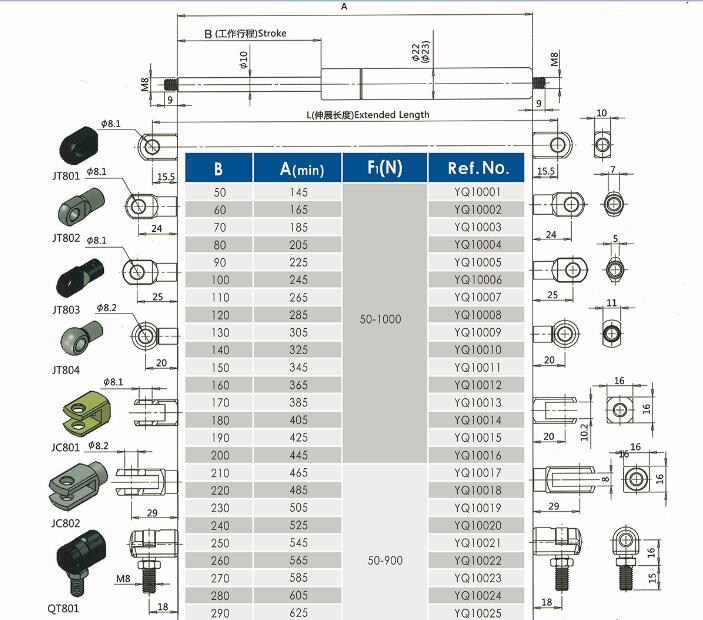
Gas springs operate by compressing nitrogen gas inside a sealed cylinder. When an external load is applied, the piston rod moves inward, increasing gas pressure and creating resistance. The force exerted by the spring depends on:
Gas Pressure: Higher pressure results in greater force.
Piston Rod Diameter: A larger rod displaces more gas, increasing force.
Stroke Length: Force may vary slightly over the stroke due to gas compression dynamics.
The force is typically measured in Newtons (N) or pounds-force (lbf) and is specified at both extended and compressed positions.
Types of Gas Spring Force Characteristics
Constant Force Springs – Provide near-uniform force throughout the stroke (ideal for lifting applications like car hoods).
Progressive Force Springs – Force increases as the spring compresses (used where higher resistance is needed at full compression).
Damping-Adjustable Springs – Allow force modulation for controlled motion (common in industrial machinery).
Factors Affecting Gas Spring Force
Temperature: Cold reduces gas pressure, decreasing force; heat increases it.
Wear & Gas Leakage: Over time, seal degradation can lower force output.
Mounting Angle: Vertical vs. horizontal installation affects force distribution.
Applications Based on Force Requirements
Light-Duty (50–200 N): Office chairs, laptop stands.
Medium-Duty (200–1000 N): Automotive hatches, medical equipment.
Heavy-Duty (1000–5000 N+): Industrial presses, aircraft landing gear.
Conclusion
Gas spring force is a fundamental aspect of its functionality, influencing load capacity, motion control, and longevity. Proper selection based on force requirements ensures optimal performance in applications ranging from furniture to heavy machinery. Engineers must consider pressure, rod size, and environmental conditions to achieve the desired balance between strength and smooth operation.